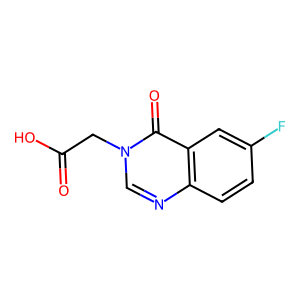
2-(6-Fluoro-4-oxo-3,4-dihydroquinazolin-3-yl)acetic acid
Names and Identifiers of 1000933-33-4
CAS Number |
1000933-33-4 |
|---|---|
MDL Number |
MFCD09971501 |
IUPAC Name |
2-(6-fluoro-4-oxoquinazolin-3-yl)acetic acid |
InChI |
InChI=1S/C10H7FN2O3/c11-6-1-2-8-7(3-6)10(16)13(5-12-8)4-9(14)15/h1-3,5H,4H2,(H,14,15) |
InChIKey |
YSPAAPIWKXQRPT-UHFFFAOYSA-N |
Canonical SMILES |
C1=CC2=C(C=C1F)C(=O)N(C=N2)CC(=O)O |
UNSPSC Code |
12352100 |
Physical and chemical properties of 1000933-33-4
Acidity coefficient |
3.53±0.10(Predicted) |
|---|---|
Boiling Point |
457.8±55.0 °C(Predicted) |
Density |
1.51±0.1 g/cm3(Predicted) |
H Bond Acceptors |
4 |
H Bond Donors |
1 |
LogP |
-0.323087698247302 |
Molecular Formula |
C10H7FN2O3 |
Molecular Weight |
222.17 |
Safety Information of 1000933-33-4

Applications of 1000933-33-4
The primary applications of 2-(6-Fluoro-4-oxo-3,4-dihydroquinazolin-3-yl)acetic acid include:
- Pharmaceutical Development: As a lead compound for developing new drugs targeting bacterial infections or cancer.
- Research Tool: Utilized in biochemical assays to study enzyme inhibition and biological pathways.
Its unique structure also makes it suitable for further modifications to enhance efficacy or reduce toxicity.
Interaction Studies of 1000933-33-4
Interaction studies involving 2-(6-Fluoro-4-oxo-3,4-dihydroquinazolin-3-yl)acetic acid focus on its binding affinity to various biological targets. These studies often employ techniques such as:
- Molecular docking: To predict how the compound interacts with target proteins.
- In vitro assays: To assess the biological activity and mechanism of action against specific pathogens or cancer cells.
Such studies are crucial for understanding the therapeutic potential and safety profile of the compound.
Biological Activity of 1000933-33-4
Research indicates that compounds related to quinazolinones exhibit a range of biological activities, including antimicrobial, anti-inflammatory, and anticancer effects. Specifically, derivatives of 2-(6-Fluoro-4-oxo-3,4-dihydroquinazolin-3-yl)acetic acid have shown promise as inhibitors of various enzymes and receptors involved in disease processes. For instance, studies have highlighted their potential in targeting mycobacterial infections by inhibiting specific dehydrogenases.