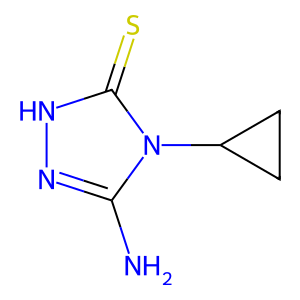
5-amino-4-cyclopropyl-4H-1,2,4-triazole-3-thiol
Names and Identifiers of 1000933-23-2
CAS Number |
1000933-23-2 |
|---|---|
EC Number |
823-422-4 |
MDL Number |
MFCD28394350 |
IUPAC Name |
3-amino-4-cyclopropyl-1H-1,2,4-triazole-5-thione |
InChI |
InChI=1S/C5H8N4S/c6-4-7-8-5(10)9(4)3-1-2-3/h3H,1-2H2,(H2,6,7)(H,8,10) |
InChIKey |
AYGLNHBCKFNEAF-UHFFFAOYSA-N |
Canonical SMILES |
C1CC1N2C(=NNC2=S)N |
UNSPSC Code |
12352100 |
Physical and chemical properties of 1000933-23-2
Boiling Point |
250.4±23.0 °C(Predicted) |
|---|---|
Density |
1.91±0.1 g/cm3(Predicted) |
H Bond Acceptors |
2 |
H Bond Donors |
2 |
LogP |
0.742872903 |
Molecular Formula |
C5H8N4S |
Molecular Weight |
156.21 |
Safety Information of 1000933-23-2

Applications of 1000933-23-2
5-amino-4-cyclopropyl-4H-1,2,4-triazole-3-thiol has various applications across different fields:
- Medicinal Chemistry: Its biological activities make it a candidate for drug development targeting specific diseases.
- Agricultural Chemicals: Potential use as an agrochemical due to its interaction with plant enzymes.
- Material Science: Its unique properties may lend themselves to applications in developing new materials .
Interaction Studies of 1000933-23-2
Interaction studies focus on understanding how 5-amino-4-cyclopropyl-4H-1,2,4-triazole-3-thiol binds with biological targets. Techniques such as molecular docking and enzyme assays are commonly used to elucidate these interactions. These studies are crucial for developing derivatives with improved efficacy and specificity for therapeutic applications .
Biological Activity of 1000933-23-2
The compound exhibits significant biological activity due to its ability to interact with various biomolecules. It has been shown to influence enzyme activity, cellular signaling pathways, and gene expression. For instance, it can modulate the activity of kinases and phosphatases, affecting signal transduction processes. Additionally, its thiol group allows it to form covalent bonds with cysteine residues in proteins, potentially inhibiting enzyme functions .
Molecular MechanismAt the molecular level, 5-amino-4-cyclopropyl-4H-1,2,4-triazole-3-thiol interacts with specific enzymes and receptors. This interaction can lead to either inhibition or activation of their activities, depending on the biological context. The compound's ability to bind to key proteins in cellular pathways suggests potential therapeutic applications .