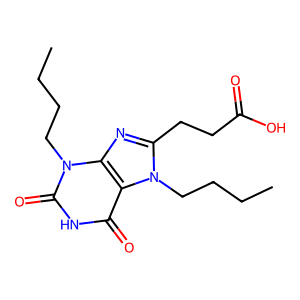
3-(3,7-dibutyl-2,6-dioxo-2,3,6,7-tetrahydro-1H-purin-8-yl)propanoic acid
Names and Identifiers of 1000932-99-9
CAS Number |
1000932-99-9 |
|---|---|
IUPAC Name |
3-(3,7-dibutyl-2,6-dioxopurin-8-yl)propanoic acid |
InChI |
InChI=1S/C16H24N4O4/c1-3-5-9-19-11(7-8-12(21)22)17-14-13(19)15(23)18-16(24)20(14)10-6-4-2/h3-10H2,1-2H3,(H,21,22)(H,18,23,24) |
InChIKey |
NGYGSIFVWFYKAC-UHFFFAOYSA-N |
Canonical SMILES |
CCCCN1C(=NC2=C1C(=O)NC(=O)N2CCCC)CCC(=O)O |
Physical and chemical properties of 1000932-99-9
Molecular Formula |
C16H24N4O4 |
|---|---|
Molecular Weight |
336.39 |
Safety Information of 1000932-99-9

Applications of 1000932-99-9
This compound serves several important roles in scientific research:
- Chemistry: It acts as a building block for synthesizing more complex molecules.
- Biology: It is utilized as a model compound for studying purine metabolism and its derivatives.
- Industry: It finds applications in producing specialty chemicals and materials.
Interaction Studies of 1000932-99-9
Research on the interactions of 3-(3,7-dibutyl-2,6-dioxo-2,3,6,7-tetrahydro-1H-purin-8-yl)propanoic acid with biological targets has revealed its potential to influence enzymatic activities related to purine metabolism. This makes it a valuable compound for understanding metabolic pathways and developing therapeutic agents targeting these pathways.
Biological Activity of 1000932-99-9
3-(3,7-dibutyl-2,6-dioxo-2,3,6,7-tetrahydro-1H-purin-8-yl)propanoic acid has been studied for its potential biological activities. It is known to interact with enzymes involved in purine metabolism, potentially inhibiting or modulating their activity. This interaction can affect various biochemical pathways, making it a subject of interest in pharmacological research.