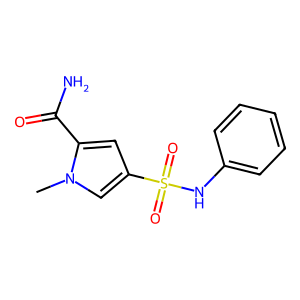
1-methyl-4-(phenylsulfamoyl)-1H-pyrrole-2-carboxamide
Names and Identifiers of 1000932-96-6
CAS Number |
1000932-96-6 |
|---|---|
MDL Number |
MFCD09863421 |
IUPAC Name |
1-methyl-4-(phenylsulfamoyl)pyrrole-2-carboxamide |
InChI |
InChI=1S/C12H13N3O3S/c1-15-8-10(7-11(15)12(13)16)19(17,18)14-9-5-3-2-4-6-9/h2-8,14H,1H3,(H2,13,16) |
InChIKey |
DSUAOTKDMKUCLW-UHFFFAOYSA-N |
Canonical SMILES |
CN1C=C(C=C1C(=O)N)S(=O)(=O)NC2=CC=CC=C2 |
UNSPSC Code |
12352100 |
Physical and chemical properties of 1000932-96-6
Acidity coefficient |
8.17±0.48(Predicted) |
|---|---|
Boiling Point |
506.6±60.0 °C(Predicted) |
Density |
1.41±0.1 g/cm3(Predicted) |
H Bond Acceptors |
3 |
H Bond Donors |
2 |
LogP |
0.535112696333333 |
Molecular Formula |
C12H13N3O3S |
Molecular Weight |
279.31 |
Safety Information of 1000932-96-6

Applications of 1000932-96-6
The applications of 1-methyl-4-(phenylsulfamoyl)-1H-pyrrole-2-carboxamide span across several fields:
- Pharmaceutical Research: As a lead compound for developing new antimicrobial or anti-inflammatory agents.
- Chemical Biology: As a tool in studying biological pathways related to inflammation or infection.
- Material Science: Potential use in developing novel materials due to its unique chemical structure.
Its diverse applications highlight its importance in both medicinal chemistry and materials science.
Interaction Studies of 1000932-96-6
Interaction studies are crucial for understanding how 1-methyl-4-(phenylsulfamoyl)-1H-pyrrole-2-carboxamide interacts with biological systems. These studies may include:
- Binding Affinity Assessments: Evaluating how well the compound binds to specific biological targets (e.g., enzymes or receptors).
- In Vivo Studies: Investigating the pharmacokinetics and pharmacodynamics in animal models to assess efficacy and safety.
- Mechanistic Studies: Understanding the biochemical pathways affected by this compound, which could reveal new therapeutic targets.
Such studies contribute significantly to drug development processes.
Biological Activity of 1000932-96-6
1-Methyl-4-(phenylsulfamoyl)-1H-pyrrole-2-carboxamide has been studied for its biological activities, particularly in the context of pharmacology. Compounds with sulfamoyl groups are often associated with antimicrobial and anti-inflammatory properties. Preliminary studies suggest that this compound may exhibit:
- Antimicrobial Activity: Potential effectiveness against various bacterial strains.
- Anti-inflammatory Properties: Possible inhibition of inflammatory pathways, making it a candidate for treating inflammatory diseases.
Further investigations are necessary to elucidate its exact mechanisms of action and therapeutic potential.