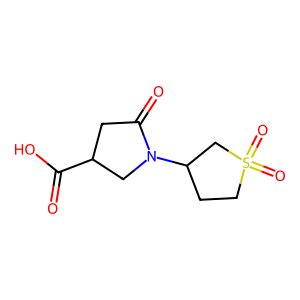
1-(1,1-Dioxidotetrahydrothien-3-yl)-5-oxopyrrolidine-3-carboxylic acid
CAS No.:
1000932-78-4
M. Wt:
247.27
M. Fa:
C9H13NO5S
InChI Key:
LTTAUOWOFBCYRZ-UHFFFAOYSA-N
Names and Identifiers of 1000932-78-4
CAS Number |
1000932-78-4 |
|---|---|
EC Number |
874-135-6 |
IUPAC Name |
1-(1,1-dioxothiolan-3-yl)-5-oxopyrrolidine-3-carboxylic acid |
InChI |
InChI=1S/C9H13NO5S/c11-8-3-6(9(12)13)4-10(8)7-1-2-16(14,15)5-7/h6-7H,1-5H2,(H,12,13) |
InChIKey |
LTTAUOWOFBCYRZ-UHFFFAOYSA-N |
Canonical SMILES |
C1CS(=O)(=O)CC1N2CC(CC2=O)C(=O)O |
Physical and chemical properties of 1000932-78-4
Boiling Point |
613.3±55.0 °C(Predicted) |
|---|---|
Density |
1.570±0.06 g/cm3(Predicted) |
Molecular Formula |
C9H13NO5S |
Molecular Weight |
247.27 |
Safety Information of 1000932-78-4

Applications of 1000932-78-4
This compound has several potential applications:
- Proteomics research: Due to its ability to interact with proteins and enzymes, it can be utilized in studies aimed at understanding protein functions and interactions.
- Pharmaceutical development: Its biological activity makes it a candidate for drug development, particularly in antimicrobial and anticancer therapies.
- Chemical biology: It can serve as a tool compound in chemical biology studies to probe biological pathways.
Interaction Studies of 1000932-78-4
Interaction studies reveal that 1-(1,1-Dioxidotetrahydrothien-3-yl)-5-oxopyrrolidine-3-carboxylic acid can bind to various biological macromolecules. These studies often employ techniques such as:
- Surface Plasmon Resonance (SPR): To measure binding kinetics and affinities.
- Nuclear Magnetic Resonance (NMR): To elucidate binding modes and conformational changes upon interaction.
- Mass Spectrometry (MS): For analyzing complex mixtures and identifying binding partners.
Such studies are crucial for understanding its mechanism of action and potential therapeutic uses.
Biological Activity of 1000932-78-4
Research indicates that 1-(1,1-Dioxidotetrahydrothien-3-yl)-5-oxopyrrolidine-3-carboxylic acid exhibits notable biological activities, including:
- Antimicrobial properties: The compound may inhibit the growth of certain bacteria and fungi.
- Enzyme inhibition: It has potential as an inhibitor of specific enzymes involved in metabolic pathways.
- Cytotoxic effects: Preliminary studies suggest it could induce apoptosis in cancer cell lines, making it a candidate for anticancer research.