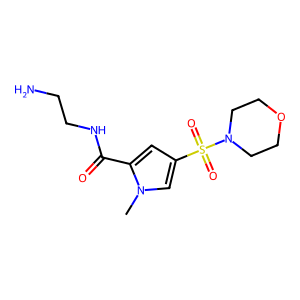
N-(2-aminoethyl)-1-methyl-4-(morpholine-4-sulfonyl)-1H-pyrrole-2-carboxamide
CAS No.:
1000932-72-8
M. Wt:
316.38
M. Fa:
C12H20N4O4S
InChI Key:
KZBNVXBIDOKTSV-UHFFFAOYSA-N
Names and Identifiers of 1000932-72-8
CAS Number |
1000932-72-8 |
|---|---|
EC Number |
859-913-5 |
MDL Number |
MFCD09863397 |
IUPAC Name |
N-(2-aminoethyl)-1-methyl-4-morpholin-4-ylsulfonylpyrrole-2-carboxamide |
InChI |
InChI=1S/C12H20N4O4S/c1-15-9-10(8-11(15)12(17)14-3-2-13)21(18,19)16-4-6-20-7-5-16/h8-9H,2-7,13H2,1H3,(H,14,17) |
InChIKey |
KZBNVXBIDOKTSV-UHFFFAOYSA-N |
Canonical SMILES |
CN1C=C(C=C1C(=O)NCCN)S(=O)(=O)N2CCOCC2 |
UNSPSC Code |
12352100 |
Physical and chemical properties of 1000932-72-8
Density |
1.47±0.1 g/cm3(Predicted) |
|---|---|
H Bond Acceptors |
5 |
H Bond Donors |
2 |
LogP |
-1.69097788133333 |
Molecular Formula |
C12H20N4O4S |
Molecular Weight |
316.38 |
Safety Information of 1000932-72-8

Applications of 1000932-72-8
This compound has potential applications in:
- Pharmaceutical Development: Due to its biological activity, it may serve as a lead compound in drug discovery efforts targeting cancer or infectious diseases.
- Research Tools: It can be used in biochemical assays to study enzyme interactions or cellular responses.
- Chemical Probes: Its unique structure allows it to act as a probe in studying biological systems or pathways.
Interaction Studies of 1000932-72-8
Interaction studies involving N-(2-aminoethyl)-1-methyl-4-(morpholine-4-sulfonyl)-1H-pyrrole-2-carboxamide focus on its binding affinity to various biological targets:
- Protein-Ligand Interactions: Investigations into how this compound binds to specific proteins can reveal insights into its mechanism of action and therapeutic potential.
- Cellular Uptake Studies: Understanding how effectively the compound enters cells can inform its potential efficacy as a drug candidate.
These studies are critical for assessing the viability of this compound in clinical applications.
Biological Activity of 1000932-72-8
N-(2-aminoethyl)-1-methyl-4-(morpholine-4-sulfonyl)-1H-pyrrole-2-carboxamide exhibits significant biological activity, particularly in pharmacological contexts. Research indicates that compounds with similar structures often demonstrate:
- Antitumor Activity: Many pyrrole derivatives have been studied for their ability to inhibit cancer cell proliferation.
- Antimicrobial Properties: The morpholine moiety is frequently associated with antimicrobial effects, making this compound a candidate for further investigation in this area.
- Enzyme Inhibition: The compound may interact with specific enzymes, potentially acting as an inhibitor or modulator, which could be useful in treating various diseases.
Further studies are necessary to fully elucidate its mechanisms of action and therapeutic potential.