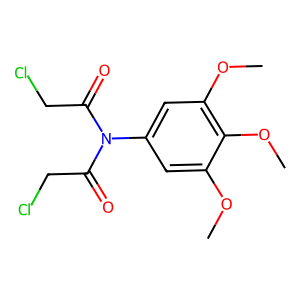
2-Chloro-n-(2-chloroacetyl)-n-(3,4,5-trimethoxyphenyl)acetamide
Names and Identifiers of 1000932-63-7
CAS Number |
1000932-63-7 |
|---|---|
MDL Number |
MFCD09971387 |
IUPAC Name |
2-chloro-N-(2-chloroacetyl)-N-(3,4,5-trimethoxyphenyl)acetamide |
InChI |
InChI=1S/C13H15Cl2NO5/c1-19-9-4-8(5-10(20-2)13(9)21-3)16(11(17)6-14)12(18)7-15/h4-5H,6-7H2,1-3H3 |
InChIKey |
UVJJMADHHHLFOV-UHFFFAOYSA-N |
Canonical SMILES |
COC1=CC(N(C(=O)CCl)C(=O)CCl)=CC(OC)=C1OC |
UNSPSC Code |
12352100 |
Physical and chemical properties of 1000932-63-7
H Bond Acceptors |
5 |
|---|---|
H Bond Donors |
0 |
LogP |
1.441628315 |
Molecular Formula |
C13H15Cl2NO5 |
Molecular Weight |
336.1700134 |
Safety Information of 1000932-63-7

Applications of 1000932-63-7
Due to its biological activity, this compound has potential applications in:
- Pharmaceutical research: As a lead compound for developing new drugs targeting UBA5 in cancer therapy.
- Chemical biology: As a tool for studying ubiquitin-like protein modification pathways.
- Synthetic chemistry: As an intermediate for synthesizing other complex organic molecules.
Interaction Studies of 1000932-63-7
Interaction studies involving 2-chloro-N-(2-chloroacetyl)-N-(3,4,5-trimethoxyphenyl)acetamide have focused on its binding affinity and inhibitory effects on UBA5. This research aids in understanding the mechanism of action and potential off-target effects. Further studies are necessary to explore its interactions with other proteins involved in cellular signaling pathways.
Biological Activity of 1000932-63-7
Preliminary studies indicate that 2-chloro-N-(2-chloroacetyl)-N-(3,4,5-trimethoxyphenyl)acetamide exhibits significant biological activity. It has been identified as a selective inhibitor of Ubiquitin-like Modifier Activating Enzyme 5 (UBA5), which plays a crucial role in protein modification pathways. The compound demonstrated an IC50 value of approximately 430 μM against UBA5, indicating its potential as a therapeutic agent in cancer treatment, particularly in pancreatic cancer cell lines.