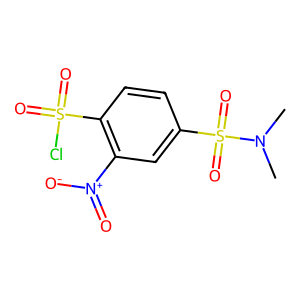
4-(Dimethylsulfamoyl)-2-nitrobenzene-1-sulfonyl chloride
Names and Identifiers of 1000932-58-0
CAS Number |
1000932-58-0 |
|---|---|
MDL Number |
MFCD09863383 |
IUPAC Name |
4-(dimethylsulfamoyl)-2-nitrobenzenesulfonyl chloride |
InChI |
InChI=1S/C8H9ClN2O6S2/c1-10(2)19(16,17)6-3-4-8(18(9,14)15)7(5-6)11(12)13/h3-5H,1-2H3 |
InChIKey |
JMPGNWKXMDCHET-UHFFFAOYSA-N |
Canonical SMILES |
CN(C)S(=O)(=O)C1=CC(=C(C=C1)S(=O)(=O)Cl)[N+](=O)[O-] |
UNSPSC Code |
12352100 |
Physical and chemical properties of 1000932-58-0
H Bond Acceptors |
6 |
|---|---|
H Bond Donors |
0 |
LogP |
0.912915934666666 |
Molecular Formula |
C8H9ClN2O6S2 |
Molecular Weight |
328.8 |
Safety Information of 1000932-58-0

Applications of 1000932-58-0
4-(Dimethylsulfamoyl)-2-nitrobenzene-1-sulfonyl chloride has several applications:
- Organic Synthesis: It serves as an intermediate in the synthesis of various organic compounds, including pharmaceuticals and agrochemicals.
- Medicinal Chemistry: The compound is utilized in drug development due to its ability to modify biological targets.
- Industrial
Interaction Studies of 1000932-58-0
Interaction studies involving 4-(dimethylsulfamoyl)-2-nitrobenzene-1-sulfonyl chloride focus on its reactivity with biological molecules. The sulfonyl chloride group facilitates nucleophilic attack from amino acids or other biomolecules, leading to the formation of stable adducts that can be analyzed for their biological effects. These studies help elucidate the compound's role in biochemical pathways and its potential therapeutic applications .
Biological Activity of 1000932-58-0
4-(Dimethylsulfamoyl)-2-nitrobenzene-1-sulfonyl chloride exhibits significant biological activity, particularly in medicinal chemistry. It is used as a probe for studying enzyme mechanisms and biological pathways. The compound's reactivity allows it to interact with various biological molecules, influencing biochemical pathways and cellular functions. Its derivatives may also have therapeutic potential in treating certain diseases due to their ability to modulate biological processes .