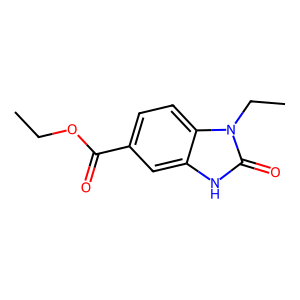
Ethyl 1-ethyl-2-oxo-2,3-dihydro-1h-1,3-benzodiazole-5-carboxylate
Names and Identifiers of 1000932-51-3
CAS Number |
1000932-51-3 |
|---|---|
MDL Number |
MFCD09971378 |
IUPAC Name |
ethyl 1-ethyl-2-oxo-2,3-dihydro-1H-1,3-benzodiazole-5-carboxylate |
InChI |
InChI=1S/C12H14N2O3/c1-3-14-10-6-5-8(11(15)17-4-2)7-9(10)13-12(14)16/h5-7H,3-4H2,1-2H3,(H,13,16) |
InChIKey |
MFSDAZAXDDRYOB-UHFFFAOYSA-N |
Canonical SMILES |
CCOC(=O)C1=CC=C2C(=C1)NC(=O)N2CC |
UNSPSC Code |
12352100 |
Physical and chemical properties of 1000932-51-3
H Bond Acceptors |
2 |
|---|---|
H Bond Donors |
1 |
LogP |
1.90750162033333 |
Molecular Formula |
C12H14N2O3 |
Molecular Weight |
234.25 |
Safety Information of 1000932-51-3

Applications of 1000932-51-3
Ethyl 1-ethyl-2-oxo-2,3-dihydro-1H-1,3-benzodiazole-5-carboxylate has several potential applications:
- Pharmaceutical Development: As a lead compound in drug discovery for anti-inflammatory and antimicrobial agents.
- Chemical Research: Used as an intermediate in synthesizing other complex organic compounds.
The compound's unique structure makes it suitable for further exploration in various fields of chemistry and medicine.
Interaction Studies of 1000932-51-3
Interaction studies are crucial for understanding how ethyl 1-ethyl-2-oxo-2,3-dihydro-1H-1,3-benzodiazole-5-carboxylate interacts with biological targets. Initial assessments may include:
- Binding Affinity Tests: Evaluating how well the compound binds to specific enzymes or receptors.
- In vitro Assays: Testing the compound's effects on cell lines to assess cytotoxicity and therapeutic potential.
These studies can help identify the compound's role in biological systems and its potential therapeutic benefits.
Biological Activity of 1000932-51-3
Ethyl 1-ethyl-2-oxo-2,3-dihydro-1H-1,3-benzodiazole-5-carboxylate exhibits various biological activities that make it a candidate for further research in pharmacology. Preliminary studies suggest potential anti-inflammatory and antimicrobial properties. The compound's interaction with biological systems may be attributed to its structural features, which allow it to interact with specific biological targets, although more detailed studies are required to elucidate its mechanisms of action.