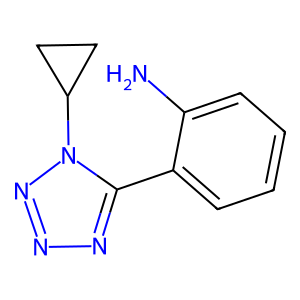
2-(1-cyclopropyl-1H-1,2,3,4-tetrazol-5-yl)aniline
Names and Identifiers of 1000932-36-4
CAS Number |
1000932-36-4 |
|---|---|
EC Number |
864-490-5 |
IUPAC Name |
2-(1-cyclopropyltetrazol-5-yl)aniline |
InChI |
InChI=1S/C10H11N5/c11-9-4-2-1-3-8(9)10-12-13-14-15(10)7-5-6-7/h1-4,7H,5-6,11H2 |
InChIKey |
KPMYWDAILDYYPN-UHFFFAOYSA-N |
Canonical SMILES |
C1CC1N2C(=NN=N2)C3=CC=CC=C3N |
Physical and chemical properties of 1000932-36-4
Molecular Formula |
C10H11N5 |
|---|---|
Molecular Weight |
201.23 |
Safety Information of 1000932-36-4

Applications of 1000932-36-4
While specific applications of 2-(1-cyclopropyl-1H-1,2,3,4-tetrazol-5-yl)aniline are not directly mentioned in the search results, tetrazole-containing compounds have diverse applications:
- Medicinal Chemistry: Tetrazoles are used in drug design as bioisosteres for carboxylic acids and amides.
- Materials Science: Tetrazole-containing compounds can be used in the development of photosensitive polymers.
- Coordination Chemistry: Tetrazoles can act as efficient metal chelators, similar to carboxylates.
Interaction Studies of 1000932-36-4
Tetrazole-containing compounds can engage in various interactions:
- Hydrogen Bonding: Tetrazoles can form up to four hydrogen bonds through their nitrogen σ-lone pairs.
- Metal Chelation: The tetrazole moiety can efficiently chelate metal ions.
- Protein Binding: In biological systems, tetrazoles can form specific interactions with amino acid residues, such as the "Arg sandwich" formation.
Several compounds share structural similarities with 2-(1-cyclopropyl-1H-1,2,3,4-tetrazol-5-yl)aniline:
- 4-(1-cyclopropyl-1H-1,2,3,4-tetrazol-5-yl)aniline: This isomer has the aniline group at the para position of the benzene ring.
- 2-(1H-tetrazol-5-yl)aniline: This compound lacks the cyclopropyl group on the tetrazole ring.
- 1-cyclopropyl-1-(1H-1,2,3,4-tetrazol-5-yl)methanamine: This compound replaces the aniline group with a methanamine group.
The uniqueness of 2-(1-cyclopropyl-1H-1,2,3,4-tetrazol-5-yl)aniline lies in its specific combination of functional groups. The presence of both the cyclopropyl and aniline groups attached to the tetrazole ring distinguishes it from other tetrazole derivatives and confers distinct chemical and potentially biological properties.
Biological Activity of 1000932-36-4
While specific biological activities of 2-(1-cyclopropyl-1H-1,2,3,4-tetrazol-5-yl)aniline are not directly reported in the provided search results, tetrazole-containing compounds are generally known for their diverse biological properties. Tetrazoles are often used as bioisosteres for carboxylic acids in medicinal chemistry due to their similar acidity and metabolic stability.