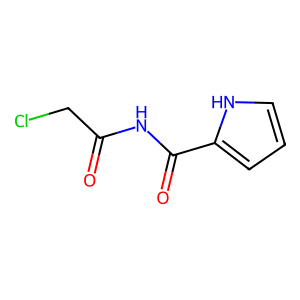
n-(2-Chloroacetyl)-1h-pyrrole-2-carboxamide
Names and Identifiers of 1000931-83-8
CAS Number |
1000931-83-8 |
|---|---|
MDL Number |
MFCD09863322 |
IUPAC Name |
N-(2-chloroacetyl)-1H-pyrrole-2-carboxamide |
InChI |
InChI=1S/C7H7ClN2O2/c8-4-6(11)10-7(12)5-2-1-3-9-5/h1-3,9H,4H2,(H,10,11,12) |
InChIKey |
HRKXWSRJLZQUFA-UHFFFAOYSA-N |
Canonical SMILES |
O=C(CCl)NC(=O)C1=CC=CN1 |
UNSPSC Code |
12352100 |
Physical and chemical properties of 1000931-83-8
Acidity coefficient |
10.01±0.46(Predicted) |
|---|---|
Boiling Point |
408.9±41.0 °C(Predicted) |
Density |
1.401±0.06 g/cm3(Predicted) |
H Bond Acceptors |
2 |
H Bond Donors |
2 |
LogP |
0.349723462333333 |
Molecular Formula |
C7H7ClN2O2 |
Molecular Weight |
186.6000061 |
Safety Information of 1000931-83-8

Applications of 1000931-83-8
N-(2-chloroacetyl)-1H-pyrrole-2-carboxamide serves several significant roles:
- Chemistry: Acts as an intermediate in synthesizing various heterocyclic compounds and pharmaceuticals.
- Biology: Investigated for its biological activities, including potential antimicrobial and anticancer effects.
- Medicine: Explored for its utility in drug development as a building block for new therapeutic agents.
- Industry: Utilized in producing agrochemicals and other industrial chemicals.
Interaction Studies of 1000931-83-8
Studies on N-(2-chloroacetyl)-1H-pyrrole-2-carboxamide focus on its interactions with biological targets. It has been shown to inhibit certain enzymes and modulate receptor activity, which could lead to therapeutic applications. Further research is needed to elucidate its full spectrum of interactions and potential side effects.
Biological Activity of 1000931-83-8
Research indicates that N-(2-chloroacetyl)-1H-pyrrole-2-carboxamide exhibits potential biological activities, particularly antimicrobial and anticancer properties. Its mechanism of action may involve interactions with specific molecular targets such as enzymes or receptors. The chloroacetyl group acts as an electrophile, facilitating covalent bonding with nucleophilic sites on proteins or other biomolecules.