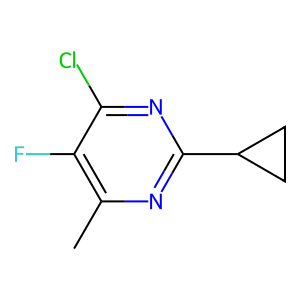
4-Chloro-2-cyclopropyl-5-fluoro-6-methylpyrimidine
Names and Identifiers of 1000931-54-3
CAS Number |
1000931-54-3 |
|---|---|
MDL Number |
MFCD09863461 |
IUPAC Name |
4-chloro-2-cyclopropyl-5-fluoro-6-methylpyrimidine |
InChI |
InChI=1S/C8H8ClFN2/c1-4-6(10)7(9)12-8(11-4)5-2-3-5/h5H,2-3H2,1H3 |
InChIKey |
GWTQXXRCLBELDX-UHFFFAOYSA-N |
Canonical SMILES |
CC1=C(C(=NC(=N1)C2CC2)Cl)F |
UNSPSC Code |
12352100 |
Physical and chemical properties of 1000931-54-3
Boiling Point |
~260.8° C at 760 mmHg (Predicted) |
|---|---|
Density |
~1.4 g/cm3(Predicted) |
Exact Mass |
186.036011 |
Flash Point |
111.5±25.9 °C |
H Bond Acceptors |
2 |
H Bond Donors |
0 |
Index of Refraction |
n20D1.56 (Predicted) |
LogP |
1.97 |
Molecular Formula |
C8H8ClFN2 |
Molecular Weight |
186.61 |
Vapour Pressure |
0.0±0.5 mmHg at 25°C |
Safety Information of 1000931-54-3

Applications of 1000931-54-3
4-Chloro-2-cyclopropyl-5-fluoro-6-methylpyrimidine has diverse applications across various fields:
- Pharmaceuticals: It serves as a building block for synthesizing more complex pharmaceutical compounds.
- Agrochemicals: The compound is utilized in developing agrochemicals due to its biological activity.
- Material Science: It is also employed in producing specialty chemicals with specific properties tailored for industrial applications.
Interaction Studies of 1000931-54-3
Research on interaction studies involving 4-Chloro-2-cyclopropyl-5-fluoro-6-methylpyrimidine has highlighted its potential effects on biological targets. Studies have demonstrated that it can act as both an agonist and antagonist depending on the receptor type it interacts with. This duality allows for modulation of receptor activity and downstream signaling pathways, making it a valuable compound in medicinal chemistry.
Biological Activity of 1000931-54-3
The biological activity of 4-Chloro-2-cyclopropyl-5-fluoro-6-methylpyrimidine has been explored due to its structural similarity to biologically active pyrimidines. It has been studied for its potential as an enzyme inhibitor and its ability to bind to various receptors, which may modulate their activity. The compound's mechanism of action typically involves binding to active or allosteric sites on enzymes, inhibiting their function and affecting downstream signaling pathways.