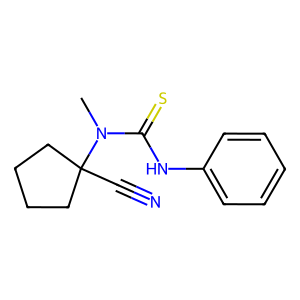
3-(1-Cyanocyclopentyl)-3-methyl-1-phenylthiourea
Names and Identifiers of 1000931-28-1
CAS Number |
1000931-28-1 |
|---|---|
MDL Number |
MFCD09863271 |
IUPAC Name |
3-(1-cyanocyclopentyl)-3-methyl-1-phenylthiourea |
InChI |
InChI=1S/C14H17N3S/c1-17(14(11-15)9-5-6-10-14)13(18)16-12-7-3-2-4-8-12/h2-4,7-8H,5-6,9-10H2,1H3,(H,16,18) |
InChIKey |
OFCNOISQVGGCKB-UHFFFAOYSA-N |
Canonical SMILES |
CN(C(=S)NC1=CC=CC=C1)C1(C#N)CCCC1 |
UNSPSC Code |
12352100 |
Physical and chemical properties of 1000931-28-1
Acidity coefficient |
12.98±0.70(Predicted) |
|---|---|
Boiling Point |
405.3±47.0 °C(Predicted) |
Density |
1.19±0.1 g/cm3(Predicted) |
H Bond Acceptors |
1 |
H Bond Donors |
1 |
LogP |
3.333413556 |
Molecular Formula |
C14H17N3S |
Molecular Weight |
259.37 |
Safety Information of 1000931-28-1

Applications of 1000931-28-1
3-(1-Cyanocyclopentyl)-3-methyl-1-phenylthiourea has potential applications in several areas:
- Pharmaceuticals: Due to its biological activity, it may serve as a lead compound in drug development targeting various diseases.
- Agriculture: Compounds with thiourea functionalities are often explored as pesticides or herbicides.
- Material Science: Its unique structural properties may allow for applications in the development of new materials or polymers.
Interaction Studies of 1000931-28-1
Studies on the interactions of 3-(1-cyanocyclopentyl)-3-methyl-1-phenylthiourea with biological macromolecules (such as proteins and nucleic acids) are crucial for understanding its mechanism of action. Preliminary data suggest that this compound may interact with specific enzymes or receptors, potentially influencing metabolic pathways related to cell proliferation and apoptosis.
Biological Activity of 1000931-28-1
Research indicates that compounds related to 3-(1-cyanocyclopentyl)-3-methyl-1-phenylthiourea exhibit significant biological activities. Specifically, thiourea derivatives have been studied for their potential anti-cancer, anti-inflammatory, and anti-diabetic effects. For instance, phenylthiourea derivatives have shown promise in inhibiting tumor growth and modulating metabolic pathways, making them candidates for further pharmacological exploration.