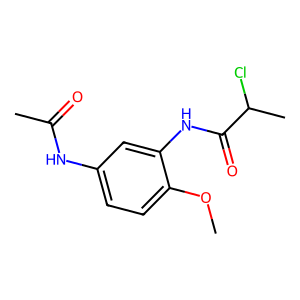
2-Chloro-n-(5-acetamido-2-methoxyphenyl)propanamide
Names and Identifiers of 1000930-64-2
CAS Number |
1000930-64-2 |
|---|---|
MDL Number |
MFCD09971334 |
IUPAC Name |
2-chloro-N-(5-acetamido-2-methoxyphenyl)propanamide |
InChI |
InChI=1S/C12H15ClN2O3/c1-7(13)12(17)15-10-6-9(14-8(2)16)4-5-11(10)18-3/h4-7H,1-3H3,(H,14,16)(H,15,17) |
InChIKey |
LIGDNBXHAHYSCZ-UHFFFAOYSA-N |
Canonical SMILES |
COC1=CC=C(NC(C)=O)C=C1NC(=O)C(C)Cl |
UNSPSC Code |
12352100 |
Physical and chemical properties of 1000930-64-2
Acidity coefficient |
12.10±0.70(Predicted) |
|---|---|
Boiling Point |
488.8±45.0 °C(Predicted) |
Density |
1.302±0.06 g/cm3(Predicted) |
H Bond Acceptors |
3 |
H Bond Donors |
2 |
LogP |
1.39710333733333 |
Molecular Formula |
C12H15ClN2O3 |
Molecular Weight |
270.71 |
Safety Information of 1000930-64-2

Applications of 1000930-64-2
2-chloro-N-(5-acetamido-2-methoxyphenyl)propanamide finds applications in various fields:
- Organic Chemistry: As a reagent in organic synthesis and as a building block for more complex molecules.
- Biological Research: In studies focusing on enzyme inhibition and protein interactions.
- Pharmaceutical Industry: Used in the synthesis of specialty chemicals and materials relevant to drug development.
Interaction Studies of 1000930-64-2
Research into the interactions of 2-chloro-N-(5-acetamido-2-methoxyphenyl)propanamide with biological molecules reveals its potential to affect enzyme activity and receptor binding. The unique combination of functional groups enhances its ability to form hydrogen bonds and engage in other molecular interactions, which may lead to significant biological effects.
Biological Activity of 1000930-64-2
The biological activity of 2-chloro-N-(5-acetamido-2-methoxyphenyl)propanamide is significant in research involving enzyme inhibition and protein interactions. The compound's structure allows it to engage with specific molecular targets, potentially modulating enzymatic activities or receptor functions. This makes it valuable in pharmacological studies aimed at understanding disease mechanisms or developing therapeutic agents.