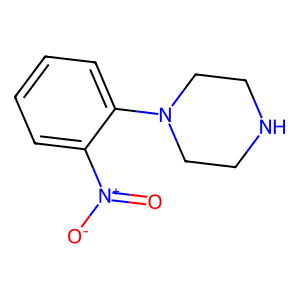
![structure of 2-Chloro-1-[4-(2-nitrophenyl)piperazin-1-yl]ethan-1-one](https://molwiki.oss-cn-hongkong.aliyuncs.com/structure/18/1000930-18-6.svg)
2-Chloro-1-[4-(2-nitrophenyl)piperazin-1-yl]ethan-1-one
Names and Identifiers of 1000930-18-6
CAS Number |
1000930-18-6 |
|---|---|
MDL Number |
MFCD09863261 |
IUPAC Name |
2-chloro-1-[4-(2-nitrophenyl)piperazin-1-yl]ethan-1-one |
InChI |
InChI=1S/C12H14ClN3O3/c13-9-12(17)15-7-5-14(6-8-15)10-3-1-2-4-11(10)16(18)19/h1-4H,5-9H2 |
InChIKey |
GYHGZSZBIKGXFR-UHFFFAOYSA-N |
Canonical SMILES |
O=C(CCl)N1CCN(C2=CC=CC=C2[N+](=O)[O-])CC1 |
UNSPSC Code |
12352100 |
Physical and chemical properties of 1000930-18-6
Exact Mass |
283.07200 |
|---|---|
H Bond Acceptors |
4 |
H Bond Donors |
0 |
LogP |
2.00830 |
Molecular Formula |
C12H14ClN3O3 |
Molecular Weight |
283.71100 |
PSA |
69.37000 |
Safety Information of 1000930-18-6

Applications of 1000930-18-6
The compound has several applications across various fields:
- Pharmaceuticals: It is explored as a potential therapeutic agent due to its interaction with neurotransmitter receptors.
- Industrial Chemistry: Used as an intermediate in synthesizing more complex molecules, particularly in developing pharmaceuticals and agrochemicals.
- Material Science: Investigated for its potential use in creating new materials with specific properties, such as polymers and coatings.
Interaction Studies of 1000930-18-6
Interaction studies are crucial for understanding how 2-Chloro-1-[4-(2-nitrophenyl)piperazin-1-yl]ethan-1-one interacts with biological targets. Preliminary findings suggest that it can bind to neurotransmitter receptors in the brain, modulating their activity and influencing neurological processes. These studies are essential for evaluating its pharmacokinetic (how the drug is absorbed, distributed, metabolized, and excreted) and pharmacodynamic (the effects of the drug on the body) properties.
Biological Activity of 1000930-18-6
Research indicates that 2-Chloro-1-[4-(2-nitrophenyl)piperazin-1-yl]ethan-1-one exhibits significant biological activity, particularly as a potential pharmacological agent. Its structure suggests possible interactions with neurotransmitter systems, which may enhance its effectiveness in treating neurological disorders. Additionally, preliminary studies have shown that it possesses antimicrobial properties, inhibiting the growth of bacteria and fungi, which makes it a candidate for applications in both pharmaceuticals and industrial settings.
 Cas:59084-06-9
