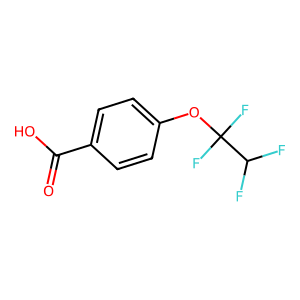
4-(1,1,2,2-TETRAFLUOROETHOXY)BENZOIC ACID
CAS No.:
10009-25-3
M. Wt:
238.136
M. Fa:
C9H6F4O3
InChI Key:
SVGWTILJZWYEMD-UHFFFAOYSA-N
Appearance:
White to Light yellow to Light orange powder to cr
Names and Identifiers of 10009-25-3
CAS Number |
10009-25-3 |
|---|---|
MDL Number |
MFCD00155926 |
IUPAC Name |
4-(1,1,2,2-tetrafluoroethoxy)benzoic acid |
InChI |
InChI=1S/C9H6F4O3/c10-8(11)9(12,13)16-6-3-1-5(2-4-6)7(14)15/h1-4,8H,(H,14,15) |
InChIKey |
SVGWTILJZWYEMD-UHFFFAOYSA-N |
Canonical SMILES |
O=C(O)C1=CC=C(OC(F)(F)C(F)F)C=C1 |
UNSPSC Code |
12352100 |
Physical and chemical properties of 10009-25-3
Acidity coefficient |
3.95±0.10(Predicted) |
|---|---|
Boiling Point |
275.3±40.0 °C at 760 mmHg |
Density |
1.4±0.1 g/cm3 |
Exact Mass |
238.025314 |
Flash Point |
120.3±27.3 °C |
Index of Refraction |
1.460 |
LogP |
3.22 |
Melting Point |
175-179 °C(lit.) |
Molecular Formula |
C9H6F4O3 |
Molecular Weight |
238.136 |
PSA |
46.53000 |
Solubility |
soluble in Methanol |
Vapour Pressure |
0.0±0.6 mmHg at 25°C |
Safety Information of 10009-25-3

Applications of 10009-25-3
4-(1,1,2,2-Tetrafluoroethoxy)benzoic acid finds applications in several domains:
- Pharmaceuticals: Its unique properties make it a candidate for drug development aimed at improving bioavailability and targeting specific biological pathways.
- Materials Science: The compound's fluorinated structure enhances thermal stability and chemical resistance, making it suitable for advanced materials.
- Agricultural Chemistry: Potential use as an agrochemical due to its biological activity against pests and pathogens.
Interaction Studies of 10009-25-3
Interaction studies involving 4-(1,1,2,2-Tetrafluoroethoxy)benzoic acid are essential for understanding its behavior in biological systems. Preliminary data suggests that the compound may interact with various proteins and enzymes due to its structural characteristics. Further studies using techniques such as molecular docking and spectroscopy are necessary to elucidate these interactions fully.