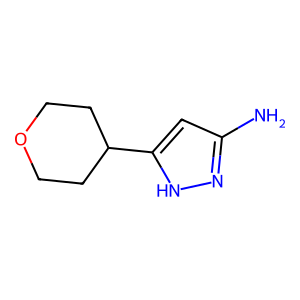
5-(tetrahydro-2H-pyran-4-yl)-1H-pyrazol-3-amine
Names and Identifiers of 1000896-69-4
CAS Number |
1000896-69-4 |
|---|---|
EC Number |
820-725-3 |
MDL Number |
MFCD20502055 |
IUPAC Name |
5-(oxan-4-yl)-1H-pyrazol-3-amine |
InChI |
InChI=1S/C8H13N3O/c9-8-5-7(10-11-8)6-1-3-12-4-2-6/h5-6H,1-4H2,(H3,9,10,11) |
InChIKey |
AQPGNHFZFXIMJB-UHFFFAOYSA-N |
Canonical SMILES |
C1COCCC1C2=CC(=NN2)N |
UNSPSC Code |
12352100 |
Physical and chemical properties of 1000896-69-4
Acidity coefficient |
15.27±0.10(Predicted) |
|---|---|
Boiling Point |
411.2±40.0 °C(Predicted) |
Density |
1.233±0.06 g/cm3(Predicted) |
Exact Mass |
167.10600 |
LogP |
1.46710 |
Molecular Formula |
C8H13N3O |
Molecular Weight |
167.20800 |
PSA |
63.93000 |
Storage condition |
2-8°C |
Safety Information of 1000896-69-4

Applications of 1000896-69-4
5-(Tetrahydro-2H-pyran-4-yl)-1H-pyrazol-3-amine has several applications across various fields:
- Chemistry: Used as a building block for synthesizing more complex organic molecules.
- Biology: Investigated for its potential biological activities, including antimicrobial and anticancer properties.
- Medicine: Explored as a therapeutic agent in treating various diseases.
- Industry: Applied in developing new materials and as a catalyst in certain
Interaction Studies of 1000896-69-4
The mechanism of action for 5-(tetrahydro-2H-pyran-4-yl)-1H-pyrazol-3-amine involves its binding to specific enzymes or receptors, which may alter their activity. Studies have shown that its structural features contribute to its effectiveness in modulating biological pathways, making it a candidate for further research into its therapeutic potential.
Biological Activity of 1000896-69-4
Research indicates that 5-(tetrahydro-2H-pyran-4-yl)-1H-pyrazol-3-amine has potential biological activities, particularly in the fields of antimicrobial and anticancer research. The compound's interaction with specific molecular targets may alter enzyme or receptor activity, leading to various therapeutic effects. Its unique structure enables it to act as a building block for more complex molecules in medicinal chemistry.
Physical sample testing spectrum (NMR) of 1000896-69-4
