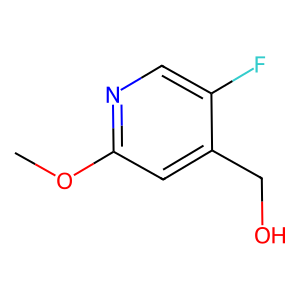
(5-Fluoro-2-methoxypyridin-4-yl)methanol
Names and Identifiers of 1000895-80-6
CAS Number |
1000895-80-6 |
|---|---|
MDL Number |
MFCD16607042 |
IUPAC Name |
(5-fluoro-2-methoxypyridin-4-yl)methanol |
InChI |
InChI=1S/C7H8FNO2/c1-11-7-2-5(4-10)6(8)3-9-7/h2-3,10H,4H2,1H3 |
InChIKey |
GESKOFMAAHVWFR-UHFFFAOYSA-N |
Canonical SMILES |
COC1=NC=C(C(=C1)CO)F |
UNSPSC Code |
12352100 |
Physical and chemical properties of 1000895-80-6
Exact Mass |
157.05400 |
|---|---|
LogP |
0.72160 |
Molecular Formula |
C7H8FNO2 |
Molecular Weight |
157.14200 |
PSA |
42.35000 |
Safety Information of 1000895-80-6

Applications of 1000895-80-6
(5-Fluoro-2-methoxypyridin-4-yl)methanol has potential applications in various fields:
- Pharmaceuticals: Due to its anti-inflammatory properties, it may be developed into drugs targeting inflammatory conditions.
- Agriculture: Its antimicrobial properties suggest possible use as a pesticide or fungicide.
- Chemical Intermediates: It serves as a precursor for synthesizing more complex organic compounds in chemical research.
Interaction Studies of 1000895-80-6
Interaction studies involving (5-Fluoro-2-methoxypyridin-4-yl)methanol have focused on its binding affinity to various biological receptors and enzymes. Preliminary data suggest that this compound can interact with targets involved in inflammatory pathways, making it a candidate for further pharmacological investigation. Additionally, studies on its interaction with metal ions indicate potential applications in coordination chemistry.
Biological Activity of 1000895-80-6
Research indicates that (5-Fluoro-2-methoxypyridin-4-yl)methanol exhibits significant biological activity, particularly in anti-inflammatory and antimicrobial domains. The presence of the fluorine atom enhances its potency against various biological targets. Studies have shown that similar pyridine derivatives can inhibit pro-inflammatory cytokines, suggesting potential therapeutic applications in treating inflammatory diseases and infections.