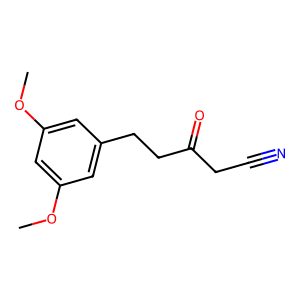
5-(3,5-Dimethoxyphenyl)-3-oxopentanenitrile
CAS No.:
1000895-54-4
M. Wt:
233.26300
M. Fa:
C13H15NO3
InChI Key:
KPKKZOWRRVLKFS-UHFFFAOYSA-N
Names and Identifiers of 1000895-54-4
CAS Number |
1000895-54-4 |
|---|---|
MDL Number |
MFCD22199282 |
IUPAC Name |
5-(3,5-dimethoxyphenyl)-3-oxopentanenitrile |
InChI |
InChI=1S/C13H15NO3/c1-16-12-7-10(8-13(9-12)17-2)3-4-11(15)5-6-14/h7-9H,3-5H2,1-2H3 |
InChIKey |
KPKKZOWRRVLKFS-UHFFFAOYSA-N |
Canonical SMILES |
COC1=CC(=CC(=C1)CCC(=O)CC#N)OC |
UNSPSC Code |
12352100 |
Physical and chemical properties of 1000895-54-4
Acidity coefficient |
9.76±0.10(Predicted) |
|---|---|
Boiling Point |
374.2±32.0 °C(Predicted) |
Density |
1.109±0.06 g/cm3(Predicted) |
Exact Mass |
233.10500 |
H Bond Acceptors |
4 |
H Bond Donors |
0 |
LogP |
2.11918 |
Molecular Formula |
C13H15NO3 |
Molecular Weight |
233.26300 |
PSA |
59.32000 |
Storage condition |
2-8°C |
Safety Information of 1000895-54-4

Applications of 1000895-54-4
5-(3,5-Dimethoxyphenyl)-3-oxopentanenitrile has potential applications in various fields:
- Pharmaceuticals: Due to its structural characteristics, it may serve as a lead compound for developing new drugs targeting inflammation or cancer.
- Chemical Research: It can be utilized as an intermediate in organic synthesis for creating more complex molecules.
- Material Science: Its unique properties might also find applications in developing novel materials with specific functionalities.
Interaction Studies of 1000895-54-4
Interaction studies involving 5-(3,5-Dimethoxyphenyl)-3-oxopentanenitrile could focus on:
- Protein Binding: Understanding how this compound interacts with biological macromolecules could provide insights into its mechanism of action.
- Enzyme Inhibition: Evaluating its potential as an enzyme inhibitor could reveal therapeutic applications in metabolic disorders or diseases driven by specific enzymes.
- Cellular Studies: Investigating cellular uptake and bioactivity in various cell lines would help elucidate its pharmacokinetic properties.