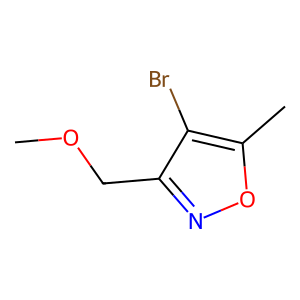
4-bromo-3-(methoxymethyl)-5-methyl-1,2-oxazole
Names and Identifiers of 1000894-06-3
CAS Number |
1000894-06-3 |
|---|---|
MDL Number |
MFCD28966189 |
IUPAC Name |
4-bromo-3-(methoxymethyl)-5-methyl-1,2-oxazole |
InChI |
InChI=1S/C6H8BrNO2/c1-4-6(7)5(3-9-2)8-10-4/h3H2,1-2H3 |
InChIKey |
FKKLSNLBZGYPDM-UHFFFAOYSA-N |
Canonical SMILES |
COCC1=NOC(C)=C1Br |
UNSPSC Code |
12352100 |
Physical and chemical properties of 1000894-06-3
Exact Mass |
204.97400 |
|---|---|
H Bond Acceptors |
2 |
H Bond Donors |
0 |
LogP |
1.89190 |
Molecular Formula |
C6H8BrNO2 |
Molecular Weight |
206.03700 |
PSA |
35.26000 |
Safety Information of 1000894-06-3

Applications of 1000894-06-3
The compound has diverse applications across various fields:
- Pharmaceutical Chemistry: It serves as a building block in synthesizing more complex pharmaceutical agents.
- Agrochemicals: Its derivatives may be utilized in developing agrochemicals with specific properties.
- Research: The compound is valuable in scientific research for studying enzyme interactions and receptor modulation.
Interaction Studies of 1000894-06-3
Interaction studies involving 4-bromo-3-(methoxymethyl)-5-methyl-1,2-oxazole focus on its binding affinity to various biological targets. The presence of the bromine atom enhances its potential for substitution reactions, while the methoxymethyl group increases solubility and interaction capabilities with biological systems. These interactions are crucial for understanding its role as a potential therapeutic agent and its mechanisms within biological pathways.
Biological Activity of 1000894-06-3
4-Bromo-3-(methoxymethyl)-5-methyl-1,2-oxazole exhibits notable biological activity. It has been investigated for its potential as an enzyme inhibitor and receptor modulator. The unique combination of substituents on the oxazole ring enhances its ability to interact with biological targets, which may lead to applications in drug discovery and development. Its mechanism of action typically involves binding to specific enzymes or receptors, modulating their activity based on structural interactions influenced by the bromine and methoxymethyl groups.