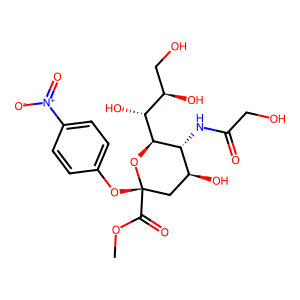
2-O-(p-Nitrophenyl)-α-D-N-glycolylneuraminic Acid Methyl Ester
Names and Identifiers of 1000890-53-8
CAS Number |
1000890-53-8 |
|---|---|
IUPAC Name |
methyl (2S,4S,5R,6R)-2-(4-nitrophenoxy)-4-oxidanyl-5-(2-oxidanylethanoylamino)-6-[(1R,2R)-1,2,3-tris(oxidanyl)propyl]oxane-2-carboxylate |
Canonical SMILES |
COC(=O)[C@]1(C[C@@H]([C@H]([C@@H](O1)[C@@H]([C@@H](CO)O)O)NC(=O)CO)O)OC2=CC=C(C=C2)[N+](=O)[O-] |
Physical and chemical properties of 1000890-53-8
Exact Mass |
460.13300 |
|---|---|
Melting Point |
111-113°C |
Molecular Formula |
C18H24N2O12 |
Molecular Weight |
460.38900 |
PSA |
220.83000 |
Solubility |
Dimethyl Sulfoxide, Methanol, Water |
Storage condition |
Refrigerator |
Applications of 1000890-53-8
The primary applications of 2-O-(p-Nitrophenyl)-alpha-D-N-glycolylneuraminic Acid Methyl Ester include:
- Proteomics Research: Used as a substrate in studies involving glycosylation patterns.
- Vaccine Development: Its ability to mimic sialic acids makes it useful in designing vaccines that target sialic acid-binding pathogens.
- Drug Development: Serves as a lead compound for developing inhibitors of sialyltransferases, which are implicated in various diseases.
These applications highlight its significance in both fundamental research and applied sciences.
Interaction Studies of 1000890-53-8
Interaction studies involving 2-O-(p-Nitrophenyl)-alpha-D-N-glycolylneuraminic Acid Methyl Ester focus on its binding affinities with various proteins and enzymes:
- Sialyltransferases: As a substrate, it provides insights into enzyme kinetics and specificity.
- Receptors: Its interactions with sialic acid-binding receptors can elucidate mechanisms of cellular adhesion and signaling.
These studies are crucial for understanding how modifications to sialic acids can affect biological processes.
Biological Activity of 1000890-53-8
2-O-(p-Nitrophenyl)-alpha-D-N-glycolylneuraminic Acid Methyl Ester exhibits notable biological activities, particularly in the context of immunology and cell biology. It serves as a substrate for various sialyltransferases, enzymes that play crucial roles in glycoprotein synthesis. Its structural similarity to naturally occurring sialic acids allows it to interact with sialic acid-binding proteins, influencing cellular recognition processes. Additionally, this compound has been shown to modulate immune responses, making it a valuable tool in studying immune mechanisms.