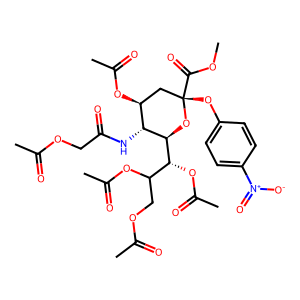
2-O-(p-Nitrophenyl)-4,7,8,9-tetra-O-acetyl-α-D-N-acetylglycolylneuraminic Acid Methyl Ester
CAS No.:
1000890-49-2
M. Wt:
670.57300
M. Fa:
C28H34N2O17
InChI Key:
-
Names and Identifiers of 1000890-49-2
CAS Number |
1000890-49-2 |
|---|---|
IUPAC Name |
methyl (2S,4S,5R,6R)-4-acetyloxy-5-(2-acetyloxyethanoylamino)-2-(4-nitrophenoxy)-6-[(1S)-1,2,3-triacetyloxypropyl]oxane-2-carboxylate |
Canonical SMILES |
CC(=O)OCC([C@H]([C@H]1[C@@H]([C@H](C[C@@](O1)(C(=O)OC)OC2=CC=C(C=C2)[N+](=O)[O-])OC(=O)C)NC(=O)COC(=O)C)OC(=O)C)OC(=O)C |
Physical and chemical properties of 1000890-49-2
Exact Mass |
670.18600 |
|---|---|
LogP |
0.95200 |
Molecular Formula |
C28H34N2O17 |
Molecular Weight |
670.57300 |
PSA |
251.18000 |
Solubility |
Chloroform, Dichloromethane, Ethyl Acetate, Methanol |
Applications of 1000890-49-2
The compound has diverse applications across various fields:
- Biochemical Research: It is used as a substrate in enzyme assays to study glycosidases and sialidases.
- Drug Development: Due to its biological activity, it may serve as a lead compound in developing antiviral drugs.
- Diagnostics: Its ability to interact with specific receptors makes it useful in diagnostic assays for detecting pathogens or studying cell surface interactions.
Interaction Studies of 1000890-49-2
Studies investigating the interactions of 2-O-(p-Nitrophenyl)-4,7,8,9-tetra-O-acetyl-alpha-D-N-acetylglycolylneuraminic Acid Methyl Ester with proteins and enzymes have revealed important insights:
- Binding Affinity: Research indicates that this compound can bind effectively to lectins and other carbohydrate-binding proteins, influencing their activity.
- Inhibition Studies: It has been shown to inhibit certain sialidases, which are enzymes that cleave sialic acids from glycoconjugates, thus affecting cellular signaling pathways.
These interaction studies are vital for understanding its potential therapeutic applications.
Biological Activity of 1000890-49-2
2-O-(p-Nitrophenyl)-4,7,8,9-tetra-O-acetyl-alpha-D-N-acetylglycolylneuraminic Acid Methyl Ester exhibits various biological activities. It is particularly noted for its role in:
- Cell Recognition: Sialic acids play crucial roles in cellular interactions and signaling processes.
- Antiviral Activity: Some studies indicate that sialic acid derivatives can inhibit viral infections by blocking viral entry into host cells.
- Immunomodulation: Compounds like this may influence immune responses due to their structural similarity to natural sialic acids found on cell surfaces.
These properties make it a valuable compound for research in immunology and virology.
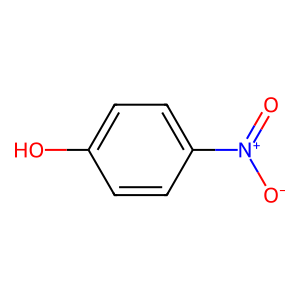 Cas:100-02-7
