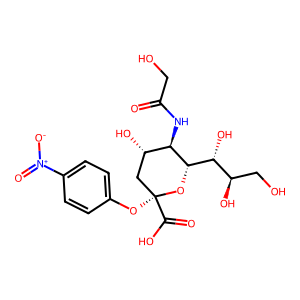
2-O-(p-Nitrophenyl)-α-D-N-glycolylneuraminic Acid
CAS No.:
1000890-36-7
M. Wt:
446.36300
M. Fa:
C17H22N2O12
InChI Key:
-
Names and Identifiers of 1000890-36-7
CAS Number |
1000890-36-7 |
|---|---|
IUPAC Name |
(2S,4S,5R,6R)-2-(4-nitrophenoxy)-4-oxidanyl-5-(2-oxidanylethanoylamino)-6-[(1R,2R)-1,2,3-tris(oxidanyl)propyl]oxane-2-carboxylic acid |
Canonical SMILES |
C1[C@@H]([C@H]([C@@H](O[C@]1(C(=O)O)OC2=CC=C(C=C2)[N+](=O)[O-])[C@@H]([C@@H](CO)O)O)NC(=O)CO)O |
Physical and chemical properties of 1000890-36-7
Exact Mass |
446.11700 |
|---|---|
Melting Point |
148-150°C |
Molecular Formula |
C17H22N2O12 |
Molecular Weight |
446.36300 |
PSA |
231.83000 |
Solubility |
Methanol, Water |
Storage condition |
-20°C Freezer |
Applications of 1000890-36-7
The compound has potential applications in various fields:
- Pharmaceuticals: Due to its biological activity, it may serve as a lead compound for developing new drugs targeting infections or oxidative stress-related diseases.
- Biotechnology: It could be used as a biochemical probe in enzyme studies or metabolic pathway analysis.
- Agriculture: If shown to possess antimicrobial properties, it could be explored as a natural pesticide or fungicide .
Interaction Studies of 1000890-36-7
Interaction studies are crucial for understanding how this compound affects biological systems:
- Binding Affinity Studies: Evaluating how well the compound binds to specific enzymes or receptors can provide insights into its mechanism of action.
- In Vivo Studies: Animal models can help assess the pharmacokinetics and pharmacodynamics of the compound.
- Molecular Docking Simulations: Computational methods can predict how the compound interacts with target proteins at the molecular level .
Biological Activity of 1000890-36-7
Research indicates that compounds structurally similar to this molecule exhibit significant biological activities, including:
- Antimicrobial Activity: Some derivatives have shown effectiveness against various bacterial strains.
- Antioxidant Properties: The presence of hydroxyl groups contributes to free radical scavenging activity.
- Enzyme Inhibition: This compound may inhibit specific enzymes involved in metabolic pathways, making it a candidate for drug development .