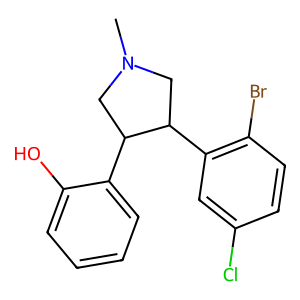
trans-N-Methyl-3-(2-hydroxyphenyl)-4-(2-bromo-5-chlorophenyl)pyrrolidine
Names and Identifiers of 1000890-02-7
CAS Number |
1000890-02-7 |
|---|---|
IUPAC Name |
2-[(3S,4S)-4-(2-bromo-5-chlorophenyl)-1-methylpyrrolidin-3-yl]phenol |
InChI |
InChI=1S/C17H17BrClNO/c1-20-9-14(12-4-2-3-5-17(12)21)15(10-20)13-8-11(19)6-7-16(13)18/h2-8,14-15,21H,9-10H2,1H3/t14-,15-/m1/s1 |
InChIKey |
GSHVIOLHJDDSSY-HUUCEWRRSA-N |
Canonical SMILES |
CN1CC(C(C1)C2=C(C=CC(=C2)Cl)Br)C3=CC=CC=C3O |
Isomeric SMILES |
CN1C[C@@H]([C@H](C1)C2=C(C=CC(=C2)Cl)Br)C3=CC=CC=C3O |
Physical and chemical properties of 1000890-02-7
Exact Mass |
365.01800 |
|---|---|
LogP |
4.55880 |
Molecular Formula |
C17H17BrClNO |
Molecular Weight |
366.68000 |
PSA |
23.47000 |
Solubility |
Chloroform (Slightly) |
Stability |
Hygroscopic |
Storage condition |
Hygroscopic, Refrigerator, under inert atmosphere |
Applications of 1000890-02-7
The applications of 2-(trans-4-(2-Bromo-5-chlorophenyl)-1-methylpyrrolidin-3-yl)phenol span several fields:
- Pharmaceutical Development: Due to its potential biological activities, it may serve as a lead compound in drug discovery for antiviral or anticancer therapies.
- Chemical Research: It can be used as a building block in organic synthesis to create more complex molecules with desired properties.
Interaction Studies of 1000890-02-7
Interaction studies focus on how this compound interacts with biological macromolecules such as proteins and nucleic acids. These studies are crucial for understanding its mechanism of action and potential side effects. Preliminary data suggest that similar compounds can bind to specific receptors or enzymes, influencing their activity and stability within biological systems.
Biological Activity of 1000890-02-7
Research indicates that 2-(trans-4-(2-Bromo-5-chlorophenyl)-1-methylpyrrolidin-3-yl)phenol exhibits notable biological activities, particularly in the realms of:
- Antiviral Activity: Compounds with similar structures have been studied for their potential antiviral properties, suggesting that this compound may also possess such capabilities.
- Anticancer Effects: Preliminary studies indicate that related compounds can inhibit cancer cell proliferation, making this compound a candidate for further investigation in oncology.
The specific mechanisms of action are still under investigation, but the presence of halogen substituents may enhance its efficacy against various biological targets.