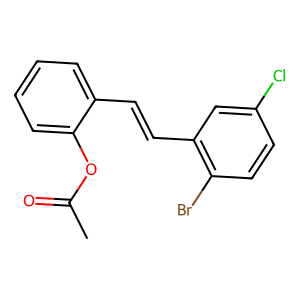
(E)-2-Acetoxy-2’-bromo-5’-chlorostilbene
Names and Identifiers of 1000890-01-6
CAS Number |
1000890-01-6 |
|---|---|
IUPAC Name |
[2-[(E)-2-(2-bromanyl-5-chloranyl-phenyl)ethenyl]phenyl] ethanoate |
Canonical SMILES |
CC(=O)OC1=CC=CC=C1/C=C/C2=C(C=CC(=C2)Cl)Br |
Physical and chemical properties of 1000890-01-6
Exact Mass |
349.97100 |
|---|---|
LogP |
5.19820 |
Molecular Formula |
C16H12BrClO2 |
Molecular Weight |
351.62200 |
PSA |
26.30000 |
Solubility |
Chloroform, Dichloromethane |
Applications of 1000890-01-6
The primary application of (E)-2-acetoxy-2'-bromo-5'-chlorostilbene lies in medicinal chemistry, particularly as an intermediate in pharmaceuticals like Asenapine. Its derivatives may also have potential applications in materials science due to their photophysical properties, making them suitable for use in organic light-emitting diodes or as fluorescent probes in biochemical assays.
Interaction Studies of 1000890-01-6
Studies on the interactions of (E)-2-acetoxy-2'-bromo-5'-chlorostilbene reveal its potential effects on various biological targets, particularly in neurotransmission. Its interactions with dopamine and serotonin receptors are crucial for understanding its pharmacological profile. Research indicates that modifications in the compound's structure can significantly alter its receptor affinity and efficacy, highlighting the importance of structure-activity relationships in drug design.
Biological Activity of 1000890-01-6
(E)-2-Acetoxy-2'-bromo-5'-chlorostilbene exhibits various biological activities, particularly in pharmacological contexts. It serves as an intermediate in the synthesis of Asenapine, an antipsychotic medication used for treating schizophrenia and bipolar disorder. The compound's activity is largely attributed to its ability to interact with neurotransmitter receptors, influencing pathways related to mood and cognition.
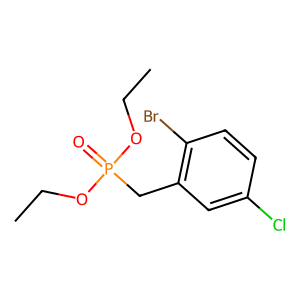 Cas:1021173-21-6

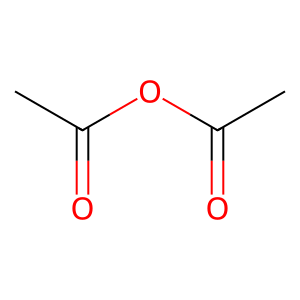 Cas:108-24-7
