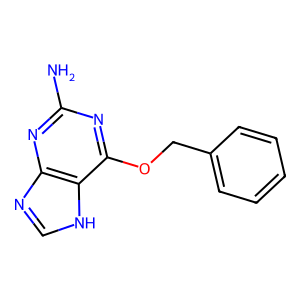
o6-Benzylguanine
Names and Identifiers of 1000874-21-4
CAS Number |
1000874-21-4 |
|---|---|
EC Number |
449-870-7 |
IUPAC Name |
6-phenylmethoxy-7H-purin-2-amine |
InChI |
InChI=1S/C12H11N5O/c13-12-16-10-9(14-7-15-10)11(17-12)18-6-8-4-2-1-3-5-8/h1-5,7H,6H2,(H3,13,14,15,16,17) |
InChIKey |
KRWMERLEINMZFT-UHFFFAOYSA-N |
Canonical SMILES |
C1=CC=C(C=C1)COC2=NC(=NC3=C2NC=N3)N |
UNII |
01KC87F8FE |
Physical and chemical properties of 1000874-21-4
Boiling Point |
621.4±63.0 °C at 760 mmHg |
|---|---|
Density |
1.4±0.1 g/cm3 |
Exact Mass |
241.096359 |
Flash Point |
329.6±33.7 °C |
Index of Refraction |
1.743 |
LogP |
1.95 |
Molecular Formula |
C12H11N5O |
Molecular Weight |
241.249 |
Solubility |
35.9 [ug/mL] (The mean of the results at pH 7.4) |
Vapour Pressure |
0.0±1.8 mmHg at 25°C |
Safety Information of 1000874-21-4

Applications of 1000874-21-4
O6-Benzylguanine has several applications:
- Cancer Treatment: It is primarily used in cancer therapy as an adjuvant to increase the effectiveness of alkylating agents.
- Research Tool: The compound serves as a valuable tool in molecular biology for studying DNA repair mechanisms and enzyme function.
- Fluorescent Labeling: Modified versions are utilized for labeling proteins and studying cellular processes through fluorescence microscopy.
Interaction Studies of 1000874-21-4
Interaction studies involving O6-benzylguanine focus on its binding affinity and specificity towards O6-alkylguanine-DNA alkyltransferase. Research indicates that mutations within the enzyme can affect its susceptibility to inhibition by O6-benzylguanine, providing insights into resistance mechanisms in cancer therapy. Additionally, studies have explored how structural modifications to O6-benzylguanine can enhance its binding properties and therapeutic potential.
Biological Activity of 1000874-21-4
The biological activity of O6-benzylguanine is primarily linked to its role as an inhibitor of DNA repair mechanisms. By inhibiting O6-alkylguanine-DNA alkyltransferase, it increases the susceptibility of cancer cells to DNA-damaging agents. This property makes it a valuable compound in cancer therapy, particularly in combination treatments where enhancing the effects of chemotherapy is desired. Additionally, studies have shown that O6-benzylguanine can induce apoptosis in resistant tumor cells by promoting DNA damage accumulation.