
1-((R)-3-Amino-pyrrolidin-1-yl)-ethanone
Names and Identifiers of 1000870-09-6
CAS Number |
1000870-09-6 |
|---|---|
MDL Number |
MFCD11849566 |
IUPAC Name |
1-[(3R)-3-aminopyrrolidin-1-yl]ethanone |
InChI |
InChI=1S/C6H12N2O/c1-5(9)8-3-2-6(7)4-8/h6H,2-4,7H2,1H3/t6-/m1/s1 |
InChIKey |
QTFVAHXVSVHNQR-ZCFIWIBFSA-N |
Canonical SMILES |
CC(=O)N1CCC(C1)N |
Isomeric SMILES |
CC(=O)N1CC[C@H](C1)N |
UNSPSC Code |
12352100 |
Physical and chemical properties of 1000870-09-6
Acidity coefficient |
8.57±0.20(Predicted) |
|---|---|
Boiling Point |
256.9±33.0 °C(Predicted) |
Density |
1.080±0.06 g/cm3(Predicted) |
Exact Mass |
164.071640 |
Molecular Formula |
C6H13ClN2O |
Molecular Weight |
164.633 |
Safety Information of 1000870-09-6

Applications of 1000870-09-6
1-((R)-3-Amino-pyrrolidin-1-yl)-ethanone finds applications across various fields:
- Medicinal Chemistry: It serves as a building block for synthesizing pharmaceuticals targeting neurological and psychiatric disorders.
- Organic Synthesis: Its unique structure makes it valuable in creating more complex organic molecules.
- Biological Research: Used in studies investigating enzyme interactions and receptor binding mechanisms.
Interaction Studies of 1000870-09-6
Interaction studies involving 1-((R)-3-Amino-pyrrolidin-1-yl)-ethanone focus on its binding affinity with various receptors or enzymes. Notable areas include:
- Enzyme Inhibition: The compound may act as an inhibitor or modulator of specific enzymes, influencing metabolic pathways.
- Receptor Binding: Its interaction with neurotransmitter receptors could provide insights into its potential therapeutic effects.
Biological Activity of 1000870-09-6
The biological activity of 1-((R)-3-Amino-pyrrolidin-1-yl)-ethanone has been the subject of research due to its potential role as a pharmacological agent. It may interact with specific molecular targets within biological systems, including enzymes and receptors. The amino group enhances its ability to form hydrogen bonds, potentially increasing its binding affinity to biological targets. Preliminary studies suggest it could have implications in the treatment of neurological disorders and other conditions requiring modulation of enzyme activity.
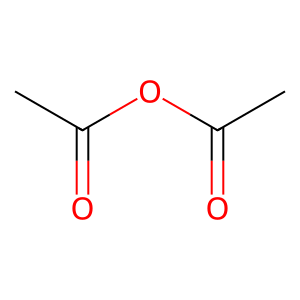 Cas:108-24-7

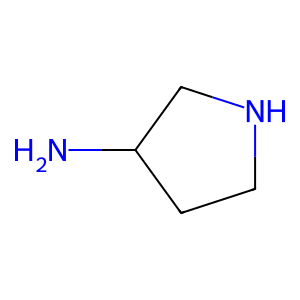 Cas:116183-82-5
