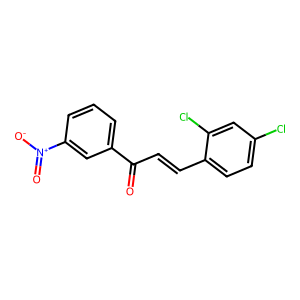
(2E)-3-(2,4-dichlorophenyl)-1-(3-nitrophenyl)prop-2-en-1-one
Names and Identifiers of 1000848-65-6
CAS Number |
1000848-65-6 |
|---|---|
MDL Number |
MFCD00089084 |
IUPAC Name |
(E)-3-(2,4-dichlorophenyl)-1-(3-nitrophenyl)prop-2-en-1-one |
InChI |
InChI=1S/C15H9Cl2NO3/c16-12-6-4-10(14(17)9-12)5-7-15(19)11-2-1-3-13(8-11)18(20)21/h1-9H/b7-5+ |
InChIKey |
FJVYPOJATLHZEX-FNORWQNLSA-N |
Canonical SMILES |
O=C(/C=C/C1=CC=C(Cl)C=C1Cl)C1=CC=CC([N+](=O)[O-])=C1 |
UNSPSC Code |
12352100 |
Physical and chemical properties of 1000848-65-6
Molecular Formula |
C15H9Cl2NO3 |
|---|---|
Molecular Weight |
322.14 |
Safety Information of 1000848-65-6

Applications of 1000848-65-6
(2E)-3-(2,4-Dichlorophenyl)-1-(3-nitrophenyl)prop-2-en-1-one has several notable applications:
- Chemistry: Serves as a starting material for synthesizing more complex organic molecules.
- Biology: Investigated for potential antimicrobial and anticancer activities.
- Medicine: Studied for therapeutic effects and as a lead compound in drug development.
- Industry: Used in developing new materials and as an intermediate in various chemical processes.
Interaction Studies of 1000848-65-6
Research on (2E)-3-(2,4-Dichlorophenyl)-1-(3-nitrophenyl)prop-2-en-1-one has focused on its interactions with specific molecular targets. These studies suggest that the compound's mechanism of action may involve inhibiting certain enzymes or receptors, leading to observed biological effects such as antimicrobial activity. Detailed interaction studies are essential for understanding its pharmacological potential and guiding further drug development efforts.
Biological Activity of 1000848-65-6
The biological activity of (2E)-3-(2,4-Dichlorophenyl)-1-(3-nitrophenyl)prop-2-en-1-one is attributed to its ability to interact with various molecular targets. The α,β-unsaturated carbonyl system can act as a Michael acceptor, allowing the compound to form covalent bonds with nucleophilic sites on proteins and enzymes. This interaction can inhibit enzyme activity or modulate protein function, contributing to its potential antimicrobial and anticancer properties. Studies have indicated that this compound may disrupt bacterial cell membranes or inhibit essential bacterial enzymes.