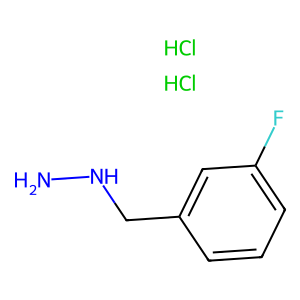
(3-Fluorobenzyl)hydrazine dihydrochloride
Names and Identifiers of 1000805-94-6
CAS Number |
1000805-94-6 |
|---|---|
EC Number |
835-575-4 |
MDL Number |
MFCD20233303 |
IUPAC Name |
(3-fluorophenyl)methylhydrazine;dihydrochloride |
InChI |
InChI=1S/C7H9FN2.2ClH/c8-7-3-1-2-6(4-7)5-10-9;;/h1-4,10H,5,9H2;2*1H |
InChIKey |
QQOXKVIRUHMNPF-UHFFFAOYSA-N |
Canonical SMILES |
C1=CC(=CC(=C1)F)CNN.Cl.Cl |
UNSPSC Code |
12352100 |
Physical and chemical properties of 1000805-94-6
Exact Mass |
176.05200 |
|---|---|
LogP |
2.68220 |
Molecular Formula |
C7H10ClFN2 |
Molecular Weight |
176.61900 |
PSA |
38.05000 |
Storage condition |
under inert gas (nitrogen or Argon) at 2-8°C |
Safety Information of 1000805-94-6

Applications of 1000805-94-6
(3-Fluorobenzyl)hydrazine dihydrochloride has several applications across different fields:
- Pharmaceuticals: It may serve as an intermediate in drug development, particularly in synthesizing antitumor agents or other therapeutic compounds.
- Agricultural Chemicals: Its ability to act as a biocide could be explored in developing new pesticides or herbicides.
- Material Science: The compound may find applications in synthesizing polymers or other advanced materials due to its reactive functional groups.
Interaction Studies of 1000805-94-6
Interaction studies involving (3-Fluorobenzyl)hydrazine dihydrochloride focus on its binding affinity with biological targets, such as enzymes or receptors. These studies are crucial for understanding its pharmacodynamics and potential therapeutic effects. Techniques such as:
- Molecular Docking Studies: To predict how the compound interacts with specific biological macromolecules.
- In Vitro Assays: To evaluate its efficacy against various pathogens or cancer cell lines.
These approaches help elucidate the mechanism of action and optimize the compound for therapeutic use.
Biological Activity of 1000805-94-6
The biological activity of (3-Fluorobenzyl)hydrazine dihydrochloride is primarily linked to its potential pharmacological effects. Hydrazines are known to exhibit various biological activities, including:
- Antitumor Activity: Some hydrazine derivatives have shown promise in cancer treatment by inducing apoptosis in cancer cells.
- Antimicrobial Properties: Certain compounds in this class can inhibit the growth of bacteria and fungi, making them potential candidates for antimicrobial agents.
- Neuroprotective Effects: There is emerging evidence suggesting that hydrazines may protect neuronal cells from oxidative stress.
The specific biological effects of (3-Fluorobenzyl)hydrazine dihydrochloride would require further investigation through bioassays and pharmacological studies.