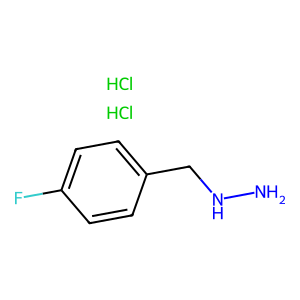
(4-Fluorobenzyl)hydrazine dihydrochloride
CAS No.:
1000805-93-5
M. Wt:
213.080
M. Fa:
C7H11Cl2FN2
InChI Key:
AKDCRZFSODMAQW-UHFFFAOYSA-N
Appearance:
white solid
Names and Identifiers of 1000805-93-5
CAS Number |
1000805-93-5 |
|---|---|
MDL Number |
MFCD06800719 |
IUPAC Name |
(4-fluorophenyl)methylhydrazine;dihydrochloride |
InChI |
InChI=1S/C7H9FN2.2ClH/c8-7-3-1-6(2-4-7)5-10-9;;/h1-4,10H,5,9H2;2*1H |
InChIKey |
AKDCRZFSODMAQW-UHFFFAOYSA-N |
Canonical SMILES |
C1=CC(=CC=C1CNN)F.Cl.Cl |
UNSPSC Code |
12352100 |
Physical and chemical properties of 1000805-93-5
Exact Mass |
212.028336 |
|---|---|
LogP |
3.48420 |
Molecular Formula |
C7H11Cl2FN2 |
Molecular Weight |
213.080 |
PSA |
38.05000 |
Safety Information of 1000805-93-5

Applications of 1000805-93-5
(4-Fluorobenzyl)hydrazine dihydrochloride has several applications, particularly in:
- Pharmaceutical Development: Its derivatives are explored for potential use as anticancer agents.
- Synthetic Chemistry: It serves as a building block in organic synthesis, particularly in developing nitrogen-containing heterocycles.
- Research: Used in proteomics and other biochemical studies due to its reactive nature and ability to form stable complexes with various biomolecules.
Interaction Studies of 1000805-93-5
Interaction studies involving (4-Fluorobenzyl)hydrazine dihydrochloride focus on its reactivity with biological macromolecules such as proteins and nucleic acids. These studies are crucial for understanding how this compound may influence biological pathways or interact with cellular components, which could lead to therapeutic applications or insights into its mechanism of action.
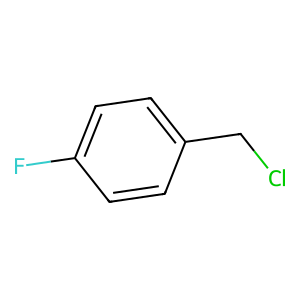 Cas:352-11-4

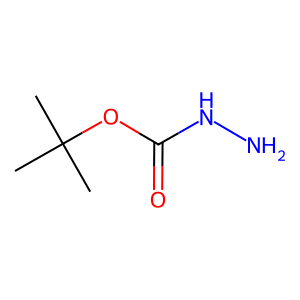 Cas:870-46-2
