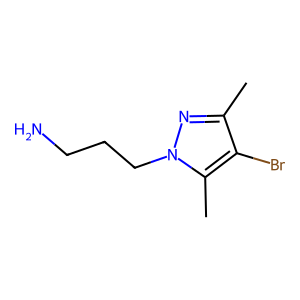
3-(4-bromo-3,5-dimethyl-1H-pyrazol-1-yl)propan-1-amine
CAS No.:
1000802-72-1
M. Wt:
232.121
M. Fa:
C8H14BrN3
InChI Key:
NJGOTAWBGADHOH-UHFFFAOYSA-N
Names and Identifiers of 1000802-72-1
CAS Number |
1000802-72-1 |
|---|---|
MDL Number |
MFCD03422556 |
IUPAC Name |
3-(4-bromo-3,5-dimethylpyrazol-1-yl)propan-1-amine |
InChI |
InChI=1S/C8H14BrN3/c1-6-8(9)7(2)12(11-6)5-3-4-10/h3-5,10H2,1-2H3 |
InChIKey |
NJGOTAWBGADHOH-UHFFFAOYSA-N |
Canonical SMILES |
CC1=C(C(=NN1CCCN)C)Br |
UNSPSC Code |
12352100 |
Physical and chemical properties of 1000802-72-1
Acidity coefficient |
9?+-.0.10(Predicted) |
|---|---|
Boiling Point |
309.9±42.0 °C at 760 mmHg |
Density |
1.5±0.1 g/cm3 |
Exact Mass |
231.037109 |
Flash Point |
141.2±27.9 °C |
Index of Refraction |
1.595 |
LogP |
1.85 |
Molecular Formula |
C8H14BrN3 |
Molecular Weight |
232.121 |
Vapour Pressure |
0.0±0.7 mmHg at 25°C |
Safety Information of 1000802-72-1

Applications of 1000802-72-1
This compound has several applications in various fields:
- Pharmaceuticals: It serves as a building block for developing new drugs due to its biological activities.
- Research: Used in proteomics and biochemical studies to explore protein interactions and functions.
- Agriculture: Potential applications in developing agrochemicals for pest control due to its antimicrobial properties.
Interaction Studies of 1000802-72-1
Interaction studies involving 3-(4-bromo-3,5-dimethyl-1H-pyrazol-1-yl)propan-1-amine focus on its binding affinity with various biological targets. Research indicates that:
- It may interact with specific enzyme systems, influencing metabolic pathways.
- Studies have shown potential interactions with receptors involved in inflammatory responses, suggesting therapeutic implications in treating inflammatory diseases.
Biological Activity of 1000802-72-1
Pyrazole derivatives, including 3-(4-bromo-3,5-dimethyl-1H-pyrazol-1-yl)propan-1-amine, have been noted for their diverse biological activities. These compounds often exhibit:
- Antimicrobial Properties: Many pyrazole derivatives show activity against various bacteria and fungi.
- Anticancer Activity: Some studies suggest that pyrazole compounds can inhibit cancer cell proliferation.
- Anti-inflammatory Effects: Certain derivatives have been reported to reduce inflammation in biological models.