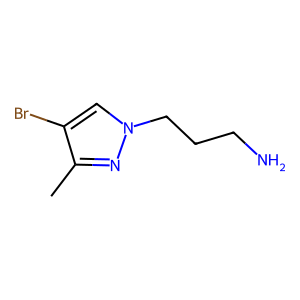
3-(4-bromo-3-methyl-1H-pyrazol-1-yl)propan-1-amine
Names and Identifiers of 1000802-71-0
CAS Number |
1000802-71-0 |
|---|---|
MDL Number |
MFCD03422555 |
IUPAC Name |
3-(4-bromo-3-methylpyrazol-1-yl)propan-1-amine |
InChI |
InChI=1S/C7H12BrN3/c1-6-7(8)5-11(10-6)4-2-3-9/h5H,2-4,9H2,1H3 |
InChIKey |
PXLXYGZGMUHEBV-UHFFFAOYSA-N |
Canonical SMILES |
CC1=NN(C=C1Br)CCCN |
UNSPSC Code |
12352100 |
Physical and chemical properties of 1000802-71-0
Exact Mass |
217.02100 |
|---|---|
LogP |
2.00310 |
Molecular Formula |
C7H12BrN3 |
Molecular Weight |
218.09400 |
PSA |
43.84000 |
Safety Information of 1000802-71-0

Applications of 1000802-71-0
3-(4-bromo-3-methyl-1H-pyrazol-1-yl)propan-1-amine has several scientific research applications:
- Chemistry: It serves as a building block in synthesizing more complex molecules.
- Biology: The compound is explored for its potential antimicrobial and anticancer properties.
- Medicine: It is investigated as a lead compound for drug development.
- Industry: Utilized in developing new materials and chemical processes.
Interaction Studies of 1000802-71-0
Interaction studies involving 3-(4-bromo-3-methyl-1H-pyrazol-1-yl)propan-1-amine focus on its binding affinities and effects on various biological targets. These studies help elucidate how the compound modulates biological pathways and its potential therapeutic applications. Specific interactions with enzymes or receptors are crucial for understanding its mechanism of action.
Biological Activity of 1000802-71-0
Research indicates that 3-(4-bromo-3-methyl-1H-pyrazol-1-yl)propan-1-amine exhibits potential biological activities. It has been investigated for its antimicrobial properties and its ability to inhibit certain cancer cell lines. The mechanism of action likely involves binding to specific enzymes or receptors, modulating their activity, which can lead to therapeutic effects.