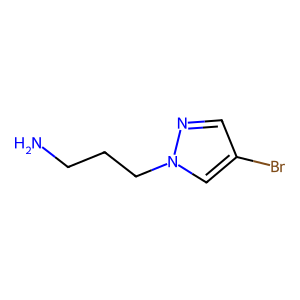
3-(4-bromo-1H-pyrazol-1-yl)propan-1-amine
Names and Identifiers of 1000802-70-9
CAS Number |
1000802-70-9 |
|---|---|
EC Number |
863-435-2 |
IUPAC Name |
3-(4-bromopyrazol-1-yl)propan-1-amine |
InChI |
InChI=1S/C6H10BrN3/c7-6-4-9-10(5-6)3-1-2-8/h4-5H,1-3,8H2 |
InChIKey |
UMQTYNMMQRQZLZ-UHFFFAOYSA-N |
Canonical SMILES |
C1=C(C=NN1CCCN)Br |
Physical and chemical properties of 1000802-70-9
Boiling Point |
288.3±20.0 °C at 760 mmHg |
|---|---|
Density |
1.6±0.1 g/cm3 |
Exact Mass |
203.005798 |
Flash Point |
128.1±21.8 °C |
Index of Refraction |
1.622 |
LogP |
0.93 |
Molecular Formula |
C6H10BrN3 |
Molecular Weight |
204.068 |
Vapour Pressure |
0.0±0.6 mmHg at 25°C |
Safety Information of 1000802-70-9

Applications of 1000802-70-9
3-(4-bromo-1H-pyrazol-1-yl)propan-1-amine has several applications in different fields:
- Medicinal Chemistry: It serves as a building block for synthesizing novel pharmaceuticals and therapeutic agents.
- Biological Research: The compound is used to study the biological activity of pyrazole derivatives and their interactions with biological targets.
- Industrial Chemistry: It is employed in the synthesis of various industrial chemicals and materials.
Interaction Studies of 1000802-70-9
Research into the interactions of 3-(4-bromo-1H-pyrazol-1-yl)propan-1-amine with biological molecules has shown that its unique structure allows it to engage in specific binding interactions. The bromine atom may facilitate halogen bonding, enhancing its affinity for certain targets. Additionally, studies have indicated that variations in substituents on the pyrazole ring can significantly affect its biological activity and pharmacological properties.
Biological Activity of 1000802-70-9
The biological activity of 3-(4-bromo-1H-pyrazol-1-yl)propan-1-amine is largely dependent on its structure and the presence of functional groups. It has been studied for its potential interactions with various biological targets, including enzymes and receptors. The bromine atom may facilitate specific binding interactions, while the amine group can participate in hydrogen bonding, influencing its binding affinity and specificity.