![structure of N-(6-iodobenzo[d][1,3]dioxol-5-yl)acetamide](https://molwiki.oss-cn-hongkong.aliyuncs.com/structure/33/1000802-33-4.svg)
N-(6-iodobenzo[d][1,3]dioxol-5-yl)acetamide
Names and Identifiers of 1000802-33-4
CAS Number |
1000802-33-4 |
|---|---|
EC Number |
689-791-7 |
MDL Number |
MFCD26399737 |
IUPAC Name |
N-(6-iodo-1,3-benzodioxol-5-yl)acetamide |
InChI |
InChI=1S/C9H8INO3/c1-5(12)11-7-3-9-8(2-6(7)10)13-4-14-9/h2-3H,4H2,1H3,(H,11,12) |
InChIKey |
KZPRZJSLLKQTSW-UHFFFAOYSA-N |
Canonical SMILES |
CC(=O)NC1=CC2=C(C=C1I)OCO2 |
UNSPSC Code |
12352100 |
Physical and chemical properties of 1000802-33-4
Exact Mass |
304.95500 |
|---|---|
LogP |
2.05130 |
Molecular Formula |
C9H8INO3 |
Molecular Weight |
305.06900 |
PSA |
47.56000 |
Safety Information of 1000802-33-4

Applications of 1000802-33-4
N-(6-iodobenzo[d][1,3]dioxol-5-yl)acetamide finds applications primarily in medicinal chemistry due to its potential biological activities. It could serve as a lead compound for developing new drugs targeting various diseases, particularly those involving oxidative stress or bacterial infections. Additionally, its unique structural properties make it suitable for research in chemical biology and pharmacology.
Interaction Studies of 1000802-33-4
Interaction studies involving N-(6-iodobenzo[d][1,3]dioxol-5-yl)acetamide focus on its binding affinity with biological targets such as enzymes and receptors. For example:
- Urease Inhibition: Studies have shown that this compound can inhibit urease activity effectively by binding to its active site.
- Antioxidant Mechanisms: Investigations into its antioxidant properties reveal that it may scavenge free radicals or modulate oxidative stress pathways.
Biological Activity of 1000802-33-4
N-(6-iodobenzo[d][1,3]dioxol-5-yl)acetamide has been evaluated for various biological activities. Studies suggest that compounds similar to this one exhibit significant antioxidant, antibacterial, and urease inhibition activities. The molecular structure aids in binding to specific biological targets, enhancing its potential therapeutic effects. For instance, molecular docking studies indicate that such compounds can effectively interact with urease enzymes through hydrogen bonding, which is crucial for their inhibitory action.
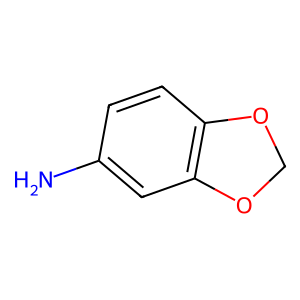 Cas:14268-66-7

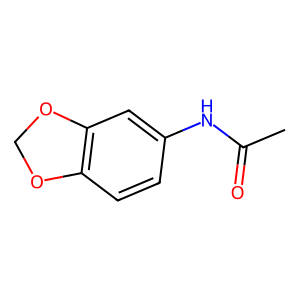 Cas:13067-19-1