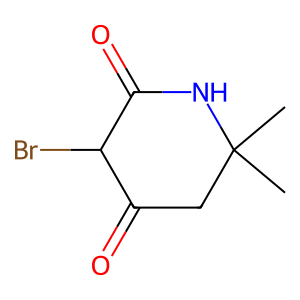
3-bromo-6,6-dimethylpiperidine-2,4-dione
Names and Identifiers of 1000801-14-8
CAS Number |
1000801-14-8 |
|---|---|
IUPAC Name |
3-bromanyl-6,6-dimethyl-piperidine-2,4-dione |
Canonical SMILES |
CC1(CC(=O)C(C(=O)N1)Br)C |
Physical and chemical properties of 1000801-14-8
Exact Mass |
218.98900 |
|---|---|
LogP |
0.94630 |
Molecular Formula |
C7H10BrNO2 |
Molecular Weight |
220.06400 |
PSA |
46.17000 |
Safety Information of 1000801-14-8

Applications of 1000801-14-8
3-Bromo-6,6-dimethylpiperidine-2,4-dione serves as an important intermediate in organic synthesis and medicinal chemistry. Its applications include:
- Drug Development: Utilized in the synthesis of pharmaceuticals and biologically active compounds.
- Chemical Research: Employed in studies exploring new synthetic methodologies and reaction mechanisms.
- Material Science: Potential use in developing novel materials with specific properties due to its unique chemical structure.
Interaction Studies of 1000801-14-8
Interaction studies involving 3-bromo-6,6-dimethylpiperidine-2,4-dione focus on its biological interactions and mechanisms of action. Preliminary studies suggest that this compound may interact with various biological targets, influencing cellular pathways relevant to disease mechanisms. Further research is needed to elucidate these interactions fully and determine the compound's efficacy in therapeutic contexts.
Biological Activity of 1000801-14-8
Research indicates that 3-bromo-6,6-dimethylpiperidine-2,4-dione exhibits notable biological activities. It has been studied for its potential as an intermediate in the synthesis of bioactive compounds, particularly in medicinal chemistry. Its derivatives have shown promise in various therapeutic areas, including antibacterial and anticancer activities. The compound's structure allows it to interact with biological targets effectively, making it a candidate for further pharmacological studies.
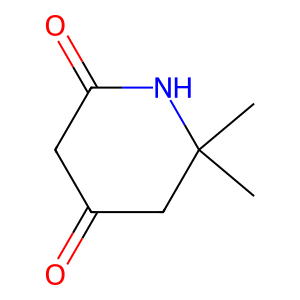 Cas:5239-39-4
