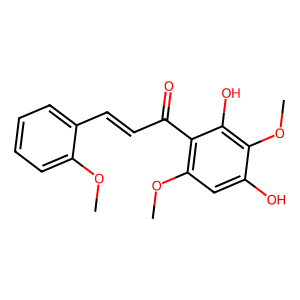
2',4'-Dihydroxy-2,3',6'-trimethoxychalcone
CAS No.:
100079-39-8
M. Wt:
330.332
M. Fa:
C18H18O6
InChI Key:
-
Names and Identifiers of 100079-39-8
CAS Number |
100079-39-8 |
|---|---|
IUPAC Name |
(E)-1-[3,6-dimethoxy-2,4-bis(oxidanyl)phenyl]-3-(2-methoxyphenyl)prop-2-en-1-one |
Canonical SMILES |
COC1=CC=CC=C1/C=C/C(=O)C2=C(C=C(C(=C2O)OC)O)OC |
Physical and chemical properties of 100079-39-8
Boiling Point |
583.0±50.0 °C at 760 mmHg |
|---|---|
Density |
1.3±0.1 g/cm3 |
Exact Mass |
330.110352 |
Flash Point |
213.3±23.6 °C |
Index of Refraction |
1.620 |
LogP |
3.41 |
Molecular Formula |
C18H18O6 |
Molecular Weight |
330.332 |
PSA |
85.22000 |
Storage condition |
2-8°C |
Vapour Pressure |
0.0±1.7 mmHg at 25°C |
Applications of 100079-39-8
The applications of 2',4'-dihydroxy-2,3',6'-trimethoxychalcone span across several fields:
- Pharmaceuticals: Its anti-inflammatory and antioxidant properties make it a candidate for developing new therapeutic agents for conditions such as arthritis and cancer.
- Cosmetics: Due to its antioxidant capacity, it is used in formulations aimed at protecting skin from oxidative damage.
- Food Industry: As a natural antioxidant, it could be incorporated into food products to enhance shelf life and nutritional value.
Interaction Studies of 100079-39-8
Interaction studies have revealed that 2',4'-dihydroxy-2,3',6'-trimethoxychalcone can interact with various biomolecules:
- Enzymatic Interactions: It inhibits enzymes such as COX-2 and lipoxygenase, which are involved in inflammatory processes.
- Protein Binding: The compound can bind to proteins involved in cellular signaling pathways, influencing gene expression and metabolic processes.
These interactions highlight its potential as a therapeutic agent by modulating biological pathways relevant to disease states.
Biological Activity of 100079-39-8
The biological activities of 2',4'-dihydroxy-2,3',6'-trimethoxychalcone are extensive and include:
- Anti-inflammatory Activity: The compound has demonstrated significant anti-inflammatory effects by inhibiting the NF-κB signaling pathway and reducing pro-inflammatory cytokine production in macrophages.
- Antioxidant Properties: It exhibits antioxidant activity by scavenging free radicals and preventing oxidative stress in cells.
- Anticancer Potential: Preliminary studies suggest that it may have cytotoxic effects on various cancer cell lines by inducing apoptosis and inhibiting cell proliferation.