
methyl 2-(propan-2-ylcarbamoylamino)benzoate
Names and Identifiers of 100075-58-9
CAS Number |
100075-58-9 |
|---|---|
MDL Number |
MFCD00262865 |
IUPAC Name |
methyl 2-{[(propan-2-yl)carbamoyl]amino}benzoate |
InChI |
InChI=1S/C12H16N2O3/c1-8(2)13-12(16)14-10-7-5-4-6-9(10)11(15)17-3/h4-8H,1-3H3,(H2,13,14,16) |
InChIKey |
MZBHWUSZUUSAKL-UHFFFAOYSA-N |
Canonical SMILES |
COC(=O)C1=CC=CC=C1NC(=O)NC(C)C |
UNSPSC Code |
12352100 |
Physical and chemical properties of 100075-58-9
Exact Mass |
236.11600 |
|---|---|
H Bond Acceptors |
2 |
H Bond Donors |
2 |
LogP |
2.46700 |
Molecular Formula |
C12H16N2O3 |
Molecular Weight |
236.26700 |
PSA |
67.43000 |
Safety Information of 100075-58-9

Applications of 100075-58-9
Methyl 2-{[(propan-2-yl)carbamoyl]amino}benzoate finds applications across various domains:
- Chemical Industry: It serves as an intermediate in synthesizing more complex organic molecules.
- Pharmaceutical Research: The compound is explored for its potential therapeutic properties, particularly in developing new drugs targeting inflammation and microbial infections.
- Biochemical Probes: It may be used as a biochemical probe to study specific biological processes or interactions.
Interaction Studies of 100075-58-9
Studies on Methyl 2-{[(propan-2-yl)carbamoyl]amino}benzoate's interactions with biological targets are ongoing. Its structure allows for potential covalent bonding with nucleophilic sites on proteins, which could alter their function. These interactions may explain its observed biological activities and help identify specific molecular pathways affected by the compound.
Biological Activity of 100075-58-9
Research indicates that Methyl 2-{[(propan-2-yl)carbamoyl]amino}benzoate exhibits potential biological activities. It has been investigated for:
- Antimicrobial Properties: The compound shows promise as an antimicrobial agent, potentially inhibiting the growth of certain bacteria and fungi.
- Anti-inflammatory Effects: Preliminary studies suggest that it may possess anti-inflammatory properties, making it a candidate for therapeutic applications in inflammatory diseases.
The exact mechanisms of action are still under investigation but may involve interactions with specific enzymes or receptors in biological pathways.
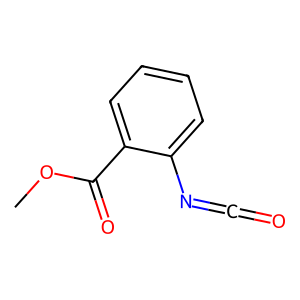 Cas:1793-07-3

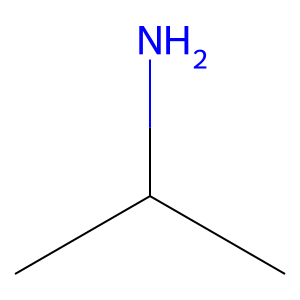 Cas:75-31-0
