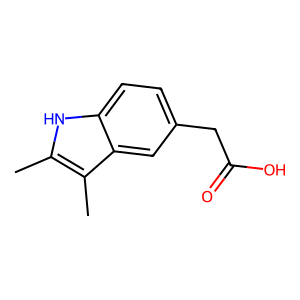
2-(2,3-Dimethyl-1H-indol-5-yl)acetic acid
CAS No.:
100068-17-5
M. Wt:
203.2409973
M. Fa:
C12H13NO2
InChI Key:
YQJMPNCDSJYOLT-UHFFFAOYSA-N
Names and Identifiers of 100068-17-5
CAS Number |
100068-17-5 |
|---|---|
MDL Number |
MFCD01464081 |
IUPAC Name |
2-(2,3-dimethyl-1H-indol-5-yl)acetic acid |
InChI |
InChI=1S/C12H13NO2/c1-7-8(2)13-11-4-3-9(5-10(7)11)6-12(14)15/h3-5,13H,6H2,1-2H3,(H,14,15) |
InChIKey |
YQJMPNCDSJYOLT-UHFFFAOYSA-N |
Canonical SMILES |
CC1=C(C)C2=CC(CC(=O)O)=CC=C2N1 |
UNSPSC Code |
12352100 |
Physical and chemical properties of 100068-17-5
H Bond Acceptors |
2 |
|---|---|
H Bond Donors |
2 |
LogP |
2.42273881066667 |
Molecular Formula |
C12H13NO2 |
Molecular Weight |
203.2409973 |
Safety Information of 100068-17-5

Applications of 100068-17-5
The applications of 2-(2,3-dimethyl-1H-indol-5-yl)acetic acid span various fields:
- Pharmaceuticals: As a potential drug candidate due to its biological activities.
- Agriculture: Studied for use as a plant growth regulator, influencing plant development processes.
- Chemical Research: Utilized as a building block in organic synthesis for developing more complex molecules.
Interaction Studies of 100068-17-5
Interaction studies have shown that 2-(2,3-dimethyl-1H-indol-5-yl)acetic acid can interact with various biological targets, including:
- Enzymes: It may inhibit or modulate enzyme activity relevant to cancer and microbial infections.
- Receptors: Potential interactions with neurotransmitter receptors suggest implications in neuropharmacology.
These interactions highlight its potential therapeutic applications and warrant further investigation into its mechanisms of action.
Biological Activity of 100068-17-5
Research indicates that 2-(2,3-dimethyl-1H-indol-5-yl)acetic acid exhibits significant biological activities. It has been studied for:
- Antimicrobial Properties: Demonstrating effectiveness against certain bacterial strains.
- Anticancer Activity: Showing potential in inhibiting cancer cell proliferation in vitro.
- Neuroprotective Effects: Indicating possible benefits in protecting neuronal cells from damage.
These activities are attributed to the compound's ability to interact with biological pathways and enzymes relevant to these processes.