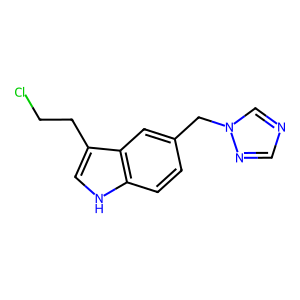
3-(2-Chloroethyl)-5-(1H-1,2,4-triazol-1-ylMethyl)-1H-indole
Names and Identifiers of 1000673-59-5
CAS Number |
1000673-59-5 |
|---|---|
IUPAC Name |
3-(2-chloroethyl)-5-(1,2,4-triazol-1-ylmethyl)-1H-indole |
Canonical SMILES |
C1=CC2=C(C=C1CN3C=NC=N3)C(=CN2)CCCl |
Physical and chemical properties of 1000673-59-5
Exact Mass |
260.08300 |
|---|---|
LogP |
2.58900 |
Molecular Formula |
C13H13ClN4 |
Molecular Weight |
260.72200 |
PSA |
46.50000 |
Applications of 1000673-59-5
The primary application of 3-(2-Chloroethyl)-5-(1H-1,2,4-triazol-1-ylmethyl)-1H-indole lies in its role as an impurity in pharmaceutical formulations of Rizatriptan Benzoate. Its structural characteristics suggest potential applications in:
- Pharmaceutical Research: Investigating its effects on serotonin receptors and exploring its therapeutic potential.
- Chemical Synthesis: Serving as a building block for synthesizing more complex indole and triazole derivatives.
Additionally, due to its biological activity, it may find applications in developing new drugs targeting various diseases.
Interaction Studies of 1000673-59-5
Interaction studies involving 3-(2-Chloroethyl)-5-(1H-1,2,4-triazol-1-ylmethyl)-1H-indole focus on its binding affinity to serotonin receptors and other biological targets. Preliminary studies indicate that compounds with similar structures can modulate receptor activity effectively. Understanding these interactions is crucial for assessing its safety profile and efficacy when used in therapeutic contexts.
Biological Activity of 1000673-59-5
3-(2-Chloroethyl)-5-(1H-1,2,4-triazol-1-ylmethyl)-1H-indole exhibits notable biological activities due to its structural components. As an impurity of Rizatriptan, it retains some pharmacological properties associated with serotonin receptor modulation. Research indicates that compounds containing indole and triazole functionalities can exhibit antimicrobial and antifungal activities. Furthermore, indole derivatives have been explored for their potential in treating neurological disorders due to their ability to interact with serotonin receptors.