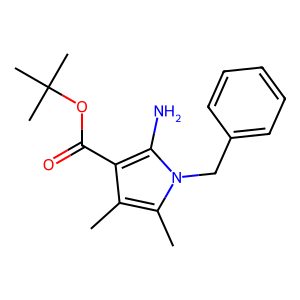
1-BENZYL-2-AMINO-3-TERT-BUTOXYCARBONYL-4,5-DIMETHYLPYRROLE
Names and Identifiers of 100066-79-3
CAS Number |
100066-79-3 |
|---|---|
IUPAC Name |
tert-butyl 2-azanyl-4,5-dimethyl-1-(phenylmethyl)pyrrole-3-carboxylate |
Canonical SMILES |
CC1=C(N(C(=C1C(=O)OC(C)(C)C)N)CC2=CC=CC=C2)C |
Physical and chemical properties of 100066-79-3
Boiling Point |
433.2ºC at 760 mmHg |
|---|---|
Exact Mass |
300.18400 |
Flash Point |
215.8ºC |
Index of Refraction |
1.547 |
LogP |
4.27190 |
Molecular Formula |
C18H24N2O2 |
Molecular Weight |
300.39500 |
PSA |
57.25000 |
Vapour Pressure |
1.04E-07mmHg at 25°C |
Applications of 100066-79-3
1-benzyl-2-amino-3-tert-butoxycarbonyl-4,5-dimethylpyrrole has potential applications in:
- Pharmaceutical Development: Its derivatives may serve as candidates for new antibiotics or antitubercular agents.
- Chemical Research: It is useful in studying structure-activity relationships within pyrrole compounds.
- Material Science: Due to its unique structure, it may find applications in developing novel materials with specific electronic or optical properties.
Interaction Studies of 100066-79-3
Interaction studies involving 1-benzyl-2-amino-3-tert-butoxycarbonyl-4,5-dimethylpyrrole have focused on its binding affinity with various biological targets. Preliminary data suggest that modifications on the pyrrole ring can significantly impact its interaction with enzymes related to bacterial metabolism. These studies are crucial for understanding how structural changes influence biological activity and therapeutic potential.
Biological Activity of 100066-79-3
Research into the biological activity of pyrrole derivatives, including 1-benzyl-2-amino-3-tert-butoxycarbonyl-4,5-dimethylpyrrole, has indicated potential antitubercular properties. Compounds within this class have shown efficacy against Mycobacterium tuberculosis, suggesting that modifications to the pyrrole scaffold can enhance biological activity. Studies have indicated that derivatives of 2,5-dimethylpyrroles exhibit promising results in inhibiting bacterial growth and may serve as lead compounds for developing new antibiotics.
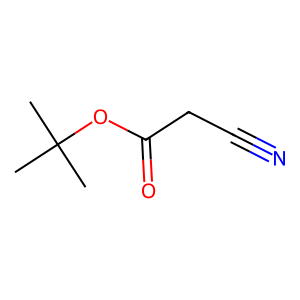 Cas:1116-98-9

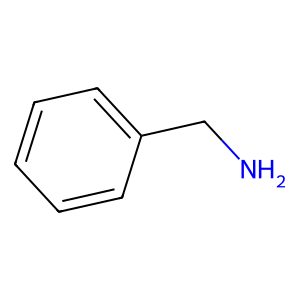 Cas:100-46-9

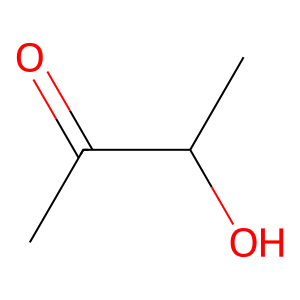 Cas:513-86-0