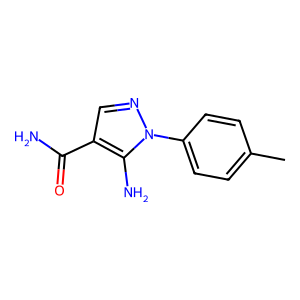
5-amino-1-(4-methylphenyl)-1H-pyrazole-4-carboxamide
CAS No.:
100061-56-1
M. Wt:
216.23900
M. Fa:
C11H12N4O
InChI Key:
MXBYCCRXPQPHBP-UHFFFAOYSA-N
Names and Identifiers of 100061-56-1
CAS Number |
100061-56-1 |
|---|---|
IUPAC Name |
5-amino-1-(4-methylphenyl)pyrazole-4-carboxamide |
InChI |
InChI=1S/C11H12N4O/c1-7-2-4-8(5-3-7)15-10(12)9(6-14-15)11(13)16/h2-6H,12H2,1H3,(H2,13,16) |
InChIKey |
MXBYCCRXPQPHBP-UHFFFAOYSA-N |
Canonical SMILES |
CC1=CC=C(C=C1)N2C(=C(C=N2)C(=O)N)N |
Physical and chemical properties of 100061-56-1
Exact Mass |
216.10100 |
|---|---|
LogP |
2.32720 |
Molecular Formula |
C11H12N4O |
Molecular Weight |
216.23900 |
PSA |
87.92000 |
Safety Information of 100061-56-1

Applications of 100061-56-1
5-amino-1-(4-methylphenyl)-1H-pyrazole-4-carboxamide has several applications in various fields:
- Pharmaceutical Development: Due to its biological activity, it is being explored for potential use as an anticancer or anti-inflammatory agent.
- Chemical Research: It serves as a reference standard in laboratories for research involving pyrazole derivatives.
- Agricultural Chemistry: There is potential for its use in developing agrochemicals due to its antimicrobial properties.
Interaction Studies of 100061-56-1
Studies on the interactions of 5-amino-1-(4-methylphenyl)-1H-pyrazole-4-carboxamide with biological targets are crucial for understanding its mechanism of action. These studies typically involve:
- Binding Affinity Assessments: Evaluating how well the compound binds to specific enzymes or receptors related to its proposed therapeutic effects.
- Cell Line Studies: Testing its efficacy against various cancer cell lines to determine cytotoxic effects and potential pathways involved.
Such studies are essential for elucidating its pharmacodynamics and pharmacokinetics.
Biological Activity of 100061-56-1
Research indicates that 5-amino-1-(4-methylphenyl)-1H-pyrazole-4-carboxamide exhibits various biological activities, primarily due to its structural characteristics. It has shown potential in:
- Antitumor Activity: Some studies suggest that this compound may inhibit the growth of certain cancer cell lines, making it a candidate for further investigation in oncology.
- Anti-inflammatory Effects: The compound may possess anti-inflammatory properties, which could be beneficial in treating conditions associated with inflammation.
- Antimicrobial Properties: Preliminary studies have indicated potential antimicrobial activity against various pathogens.
These biological activities highlight its potential as a lead compound in drug discovery.
 Cas:103646-82-8
