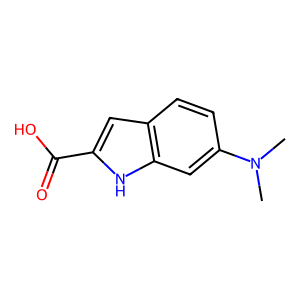
6-Dimethylamino-1H-indole-2-carboxylic acid
CAS No.:
100060-36-4
M. Wt:
204.22500
M. Fa:
C11H12N2O2
InChI Key:
VSCCUJFHSMALIB-UHFFFAOYSA-N
Names and Identifiers of 100060-36-4
CAS Number |
100060-36-4 |
|---|---|
MDL Number |
MFCD02664528 |
IUPAC Name |
6-(dimethylamino)-1H-indole-2-carboxylic acid |
InChI |
InChI=1S/C11H12N2O2/c1-13(2)8-4-3-7-5-10(11(14)15)12-9(7)6-8/h3-6,12H,1-2H3,(H,14,15) |
InChIKey |
VSCCUJFHSMALIB-UHFFFAOYSA-N |
Canonical SMILES |
CN(C)C1=CC2=C(C=C1)C=C(N2)C(=O)O |
UNSPSC Code |
12352100 |
Physical and chemical properties of 100060-36-4
Acidity coefficient |
4.15±0.30(Predicted) |
|---|---|
Boiling Point |
450.0±25.0 °C(Predicted) |
Density |
1.340±0.06 g/cm3(Predicted) |
Exact Mass |
204.09000 |
H Bond Acceptors |
3 |
H Bond Donors |
2 |
LogP |
1.93210 |
Molecular Formula |
C11H12N2O2 |
Molecular Weight |
204.22500 |
PSA |
56.33000 |
Safety Information of 100060-36-4

Applications of 100060-36-4
6-Dimethylamino-1H-indole-2-carboxylic acid has several applications across different fields:
- Pharmaceutical Research: It is utilized in drug discovery processes due to its potential therapeutic effects and biological activities.
- Chemical Probes: The compound serves as a chemical probe in biochemical assays to study enzyme interactions or cellular pathways.
- Material Science: Its unique structure allows for exploration in developing new materials with specific electronic or optical properties.
Interaction Studies of 100060-36-4
Interaction studies involving 6-Dimethylamino-1H-indole-2-carboxylic acid focus on its binding affinity to various biological targets:
- Protein-Ligand Interactions: Investigations into how this compound interacts with specific proteins can provide insights into its mechanism of action.
- Receptor Binding: Studies may evaluate its effects on neurotransmitter receptors, contributing to understanding its potential psychoactive properties.
Biological Activity of 100060-36-4
Research indicates that 6-Dimethylamino-1H-indole-2-carboxylic acid exhibits various biological activities, including:
- Antimicrobial Properties: Studies have shown that this compound can inhibit the growth of certain bacteria and fungi, making it a candidate for further exploration in antimicrobial drug development.
- Pharmacological Potential: Due to its structural similarity to other biologically active indoles, it may possess properties that influence neurotransmitter systems, potentially impacting mood and cognitive functions.