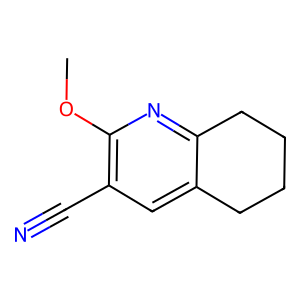
2-Methoxy-5,6,7,8-tetrahydroquinoline-3-carbonitrile
Names and Identifiers of 100060-08-0
CAS Number |
100060-08-0 |
|---|---|
MDL Number |
MFCD01011654 |
IUPAC Name |
2-methoxy-5,6,7,8-tetrahydroquinoline-3-carbonitrile |
InChI |
InChI=1S/C11H12N2O/c1-14-11-9(7-12)6-8-4-2-3-5-10(8)13-11/h6H,2-5H2,1H3 |
InChIKey |
DPHAVDMNLYZWPV-UHFFFAOYSA-N |
Canonical SMILES |
COC1=C(C=C2CCCCC2=N1)C#N |
UNSPSC Code |
12352100 |
Physical and chemical properties of 100060-08-0
Exact Mass |
188.09500 |
|---|---|
H Bond Acceptors |
3 |
H Bond Donors |
0 |
LogP |
1.84068 |
Molecular Formula |
C11H12N2O |
Molecular Weight |
188.22600 |
PSA |
45.91000 |
Safety Information of 100060-08-0

Applications of 100060-08-0
2-Methoxy-5,6,7,8-tetrahydroquinoline-3-carbonitrile has potential applications in various fields:
- Pharmaceuticals: Its anti-cancer and anti-HIV properties make it a candidate for drug development.
- Agriculture: Compounds with similar structures have been investigated for their fungicidal properties.
- Material Science: The unique structural features may lend themselves to applications in organic electronics and photonics.
Interaction Studies of 100060-08-0
Studies on the interactions of 2-methoxy-5,6,7,8-tetrahydroquinoline-3-carbonitrile with biological targets are crucial for understanding its pharmacological potential. Research has focused on:
- Cellular Mechanisms: Investigating how this compound affects cellular pathways involved in proliferation and apoptosis.
- Molecular Docking Studies: These studies help predict how the compound binds to target proteins, providing insights into its mechanism of action against cancer cells.
Biological Activity of 100060-08-0
Research indicates that 2-methoxy-5,6,7,8-tetrahydroquinoline-3-carbonitrile exhibits notable biological activities, including anti-cancer properties. It has been tested against various cancer cell lines such as human cervix carcinoma (HeLa) and colorectal adenocarcinoma (HT-29), demonstrating significant antiproliferative effects. The compound's mechanism of action may involve inducing mitochondrial membrane depolarization and reactive oxygen species production in cancer cells. Furthermore, derivatives of tetrahydroquinolines have shown promise as RET tyrosine kinase inhibitors and anti-HIV agents.