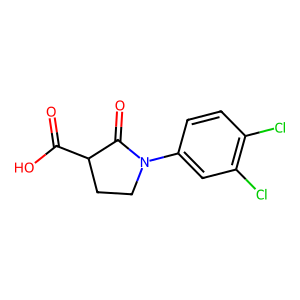
1-(3,4-Dichlorophenyl)-2-oxopyrrolidine-3-carboxylic acid
CAS No.:
10006-67-4
M. Wt:
274.10000
M. Fa:
C11H9Cl2NO3
InChI Key:
UZCXVOTUVYLHJI-UHFFFAOYSA-N
Names and Identifiers of 10006-67-4
CAS Number |
10006-67-4 |
|---|---|
IUPAC Name |
1-(3,4-dichlorophenyl)-2-oxopyrrolidine-3-carboxylic acid |
InChI |
InChI=1S/C11H9Cl2NO3/c12-8-2-1-6(5-9(8)13)14-4-3-7(10(14)15)11(16)17/h1-2,5,7H,3-4H2,(H,16,17) |
InChIKey |
UZCXVOTUVYLHJI-UHFFFAOYSA-N |
Canonical SMILES |
C1CN(C(=O)C1C(=O)O)C2=CC(=C(C=C2)Cl)Cl |
Physical and chemical properties of 10006-67-4
Acidity coefficient |
2.94±0.20(Predicted) |
|---|---|
Boiling Point |
580.6±50.0 °C(Predicted) |
Density |
1.552±0.06 g/cm3(Predicted) |
Exact Mass |
272.99600 |
LogP |
2.49590 |
Melting Point |
159-161 °C |
Molecular Formula |
C11H9Cl2NO3 |
Molecular Weight |
274.10000 |
PSA |
57.61000 |
Applications of 10006-67-4
This compound has potential applications in various fields:
- Pharmaceuticals: It may serve as a lead compound in drug development targeting pain relief or anti-inflammatory therapies.
- Biochemical Research: Its unique structure makes it useful in studying enzyme interactions and metabolic pathways.
- Chemical Manufacturing: It can be utilized as an intermediate in synthesizing other complex organic molecules.
Interaction Studies of 10006-67-4
Interaction studies involving 1-(3,4-Dichlorophenyl)-2-oxopyrrolidine-3-carboxylic acid typically focus on its binding affinity to specific biological targets. Preliminary studies suggest that it may interact with proteins involved in inflammatory responses or pain signaling pathways. Further research using techniques such as molecular docking and binding assays will help clarify its interactions and potential therapeutic uses.
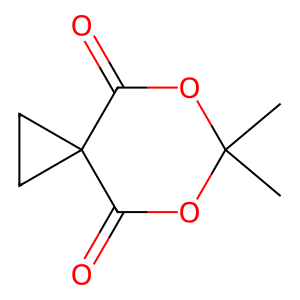 Cas:5617-70-9

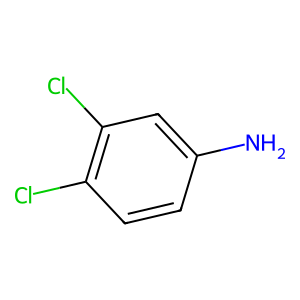 Cas:95-76-1
