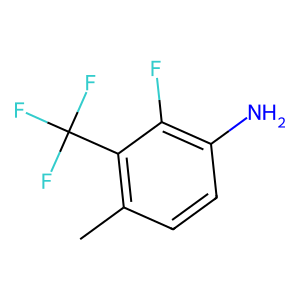
2-Fluoro-4-methyl-3-(trifluoromethyl)aniline
CAS No.:
1000590-79-3
M. Wt:
193.14100
M. Fa:
C8H7F4N
InChI Key:
SGOYXSAEVSJODM-UHFFFAOYSA-N
Names and Identifiers of 1000590-79-3
CAS Number |
1000590-79-3 |
|---|---|
MDL Number |
MFCD20725977 |
IUPAC Name |
2-fluoro-4-methyl-3-(trifluoromethyl)aniline |
InChI |
InChI=1S/C8H7F4N/c1-4-2-3-5(13)7(9)6(4)8(10,11)12/h2-3H,13H2,1H3 |
InChIKey |
SGOYXSAEVSJODM-UHFFFAOYSA-N |
Canonical SMILES |
CC1=C(C(=C(C=C1)N)F)C(F)(F)F |
UNSPSC Code |
12352100 |
Physical and chemical properties of 1000590-79-3
Exact Mass |
193.05100 |
|---|---|
LogP |
3.31630 |
Molecular Formula |
C8H7F4N |
Molecular Weight |
193.14100 |
PSA |
26.02000 |
Safety Information of 1000590-79-3

Applications of 1000590-79-3
2-Fluoro-4-methyl-3-(trifluoromethyl)aniline finds applications in several fields:
- Pharmaceuticals: As a building block in drug synthesis, particularly in developing compounds with enhanced bioactivity.
- Agrochemicals: Utilized in the formulation of pesticides and herbicides due to its potential biological activity.
- Material Science: Employed in creating specialty polymers and coatings that require specific thermal and chemical properties.
Its unique structure makes it valuable for researchers aiming to innovate within these industries.
Interaction Studies of 1000590-79-3
Studies on interaction mechanisms involving 2-fluoro-4-methyl-3-(trifluoromethyl)aniline are crucial for understanding its reactivity and potential applications. These include:
- Reactivity with Biological Molecules: Investigating how this compound interacts with proteins or nucleic acids could reveal insights into its biological effects.
- Environmental Impact Studies: Understanding how it behaves in ecological systems helps assess its safety and regulatory compliance.
Such studies are essential for developing safe applications in pharmaceuticals and agrochemicals.