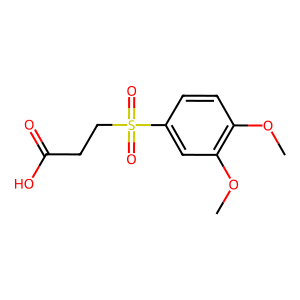
3-(3,4-Dimethoxybenzenesulfonyl)propanoic acid
Names and Identifiers of 100059-84-5
CAS Number |
100059-84-5 |
|---|---|
MDL Number |
MFCD09893520 |
IUPAC Name |
3-(3,4-dimethoxyphenyl)sulfonylpropanoic acid |
InChI |
InChI=1S/C11H14O6S/c1-16-9-4-3-8(7-10(9)17-2)18(14,15)6-5-11(12)13/h3-4,7H,5-6H2,1-2H3,(H,12,13) |
InChIKey |
KRBIPGZIRGLRBB-UHFFFAOYSA-N |
Canonical SMILES |
COC1=C(C=C(C=C1)S(=O)(=O)CCC(=O)O)OC |
UNSPSC Code |
12352100 |
Physical and chemical properties of 100059-84-5
H Bond Acceptors |
6 |
|---|---|
H Bond Donors |
1 |
LogP |
0.365397089333333 |
Molecular Formula |
C11H14O6S |
Molecular Weight |
274.29 |
Safety Information of 100059-84-5

Applications of 100059-84-5
3-(3,4-Dimethoxybenzenesulfonyl)propanoic acid has potential applications in:
- Pharmaceutical Development: Due to its biological activity, it may serve as a lead compound for drug development targeting inflammatory diseases.
- Chemical Research: It can act as an intermediate in the synthesis of more complex organic molecules.
- Material Science: Its unique chemical properties may find uses in developing new materials or coatings.
Interaction Studies of 100059-84-5
Interaction studies involving 3-(3,4-dimethoxybenzenesulfonyl)propanoic acid focus on its binding affinity to various biological targets. Preliminary data suggest that it may interact with enzymes involved in inflammatory pathways, although comprehensive studies are necessary to elucidate its mechanism of action fully. Understanding these interactions is crucial for assessing its therapeutic potential and safety profile.
Biological Activity of 100059-84-5
Research indicates that 3-(3,4-dimethoxybenzenesulfonyl)propanoic acid exhibits various biological activities. Preliminary studies suggest it may have anti-inflammatory and analgesic properties, potentially making it useful in treating pain and inflammatory conditions. Its structural similarity to other bioactive compounds suggests it could interact with specific biological targets, although detailed pharmacological studies are required to confirm these effects.