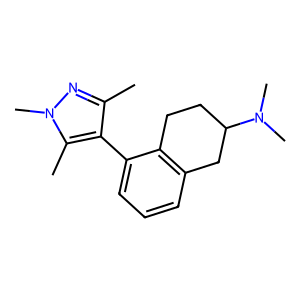
(2S)-(+)-5-(1,3,5-Trimethylpyrazol-4-YL)-2-(dimethylamino)tetralin
Names and Identifiers of 1000578-26-6
CAS Number |
1000578-26-6 |
|---|---|
IUPAC Name |
(2S)-N,N-dimethyl-5-(1,3,5-trimethylpyrazol-4-yl)-1,2,3,4-tetrahydronaphthalen-2-amine |
InChI |
InChI=1S/C18H25N3/c1-12-18(13(2)21(5)19-12)17-8-6-7-14-11-15(20(3)4)9-10-16(14)17/h6-8,15H,9-11H2,1-5H3/t15-/m0/s1 |
InChIKey |
BTTOYOKCLDAHHO-HNNXBMFYSA-N |
Canonical SMILES |
CC1=C(C(=NN1C)C)C2=CC=CC3=C2CCC(C3)N(C)C |
Isomeric SMILES |
CC1=C(C(=NN1C)C)C2=CC=CC3=C2CC[C@@H](C3)N(C)C |
UNII |
LA5AQ5R6QS |
Physical and chemical properties of 1000578-26-6
Boiling Point |
413.3±45.0 °C at 760 mmHg |
|---|---|
Density |
1.1±0.1 g/cm3 |
Exact Mass |
283.204834 |
Flash Point |
203.7±28.7 °C |
Index of Refraction |
1.595 |
LogP |
3.71 |
Molecular Formula |
C18H25N3 |
Molecular Weight |
283.411 |
Storage condition |
2-8°C |
Vapour Pressure |
0.0±1.0 mmHg at 25°C |
Applications of 1000578-26-6
AS 19 has potential applications in several fields:
- Neuroscience Research: Due to its role as a selective 5-HT7 receptor agonist, it is valuable for studying serotonin-related pathways and their implications in cognitive functions.
- Pharmacology: It may serve as a lead compound for developing therapeutics targeting mood disorders or cognitive impairments.
- Oncology: Its effect on melanin synthesis could be explored for applications in skin cancer research or treatments.
Interaction Studies of 1000578-26-6
Interaction studies involving AS 19 focus on its binding affinity and functional activity at serotonin receptors. Research indicates that AS 19 selectively activates the 5-HT7 receptor without significant interaction with other serotonin receptor subtypes. This selectivity makes it a useful tool for dissecting the role of the 5-HT7 receptor in various physiological processes.
Biological Activity of 1000578-26-6
The biological activity of AS 19 has been studied in various contexts. Notably, it enhances memory consolidation and has been shown to reverse amnesia induced by scopolamine or dizocilpine in vivo. Additionally, AS 19 promotes melanin synthesis in B16F10 murine melanoma cells, suggesting potential applications in dermatological research. The compound's selectivity for the 5-HT7 receptor over other serotonin receptor subtypes (such as 5-HT1A and 5-HT1B) further underscores its unique pharmacological profile.
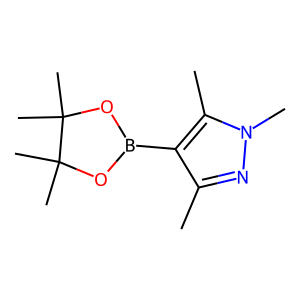 Cas:844891-04-9
