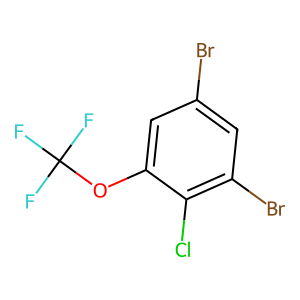
3,5-Dibromo-2-chlorotrifluoromethoxybenzene
Names and Identifiers of 1000578-24-4
CAS Number |
1000578-24-4 |
|---|---|
MDL Number |
MFCD09878142 |
IUPAC Name |
1,5-dibromo-2-chloro-3-(trifluoromethoxy)benzene |
InChI |
InChI=1S/C7H2Br2ClF3O/c8-3-1-4(9)6(10)5(2-3)14-7(11,12)13/h1-2H |
InChIKey |
IPQDWNHRSFLBRN-UHFFFAOYSA-N |
Canonical SMILES |
FC(F)(F)OC1=CC(Br)=CC(Br)=C1Cl |
UNSPSC Code |
12352100 |
Physical and chemical properties of 1000578-24-4
Exact Mass |
351.81100 |
|---|---|
LogP |
4.76360 |
Molecular Formula |
C7H2Br2ClF3O |
Molecular Weight |
354.34600 |
PSA |
9.23000 |
Safety Information of 1000578-24-4

Applications of 1000578-24-4
The applications of 3,5-Dibromo-2-chlorotrifluoromethoxybenzene are likely related to its unique structural features:
- Synthetic intermediate: It can serve as a valuable building block in the synthesis of more complex molecules, particularly in pharmaceutical and agrochemical research.
- Material science: The compound may find use in the development of functional materials, such as liquid crystals or electronic components, due to its halogenated nature.
- Fluorine chemistry: As a trifluoromethoxy-containing compound, it could be utilized in studies focused on the effects of fluorine substitution in organic molecules.
Interaction Studies of 1000578-24-4
Interaction studies involving 3,5-Dibromo-2-chlorotrifluoromethoxybenzene might focus on:
- Protein binding: The compound's ability to interact with specific protein targets, potentially influencing enzymatic activities or signaling pathways.
- Membrane interactions: Due to its lipophilic nature, studies may investigate its interactions with cellular membranes and potential impacts on membrane fluidity or permeability.
- Environmental fate: Given its halogenated structure, research might explore its persistence in the environment and potential interactions with soil or aquatic ecosystems.
3,5-Dibromo-2-chlorotrifluoromethoxybenzene shares structural similarities with several other halogenated aromatic compounds. Some similar compounds include:
- 1,5-Dibromo-2-fluoro-3-(trifluoromethyl)benzene: This compound differs in the replacement of the chlorine with fluorine and the trifluoromethoxy group with a trifluoromethyl group.
- 1,5-Dibromo-2-chloro-3-ethylbenzene: This compound has an ethyl group instead of the trifluoromethoxy group.
- 1-Azido-2-bromo-3,5-bis(trifluoromethyl)benzene: This compound features an azido group and two trifluoromethyl groups instead of the chlorine and trifluoromethoxy substituents.
The uniqueness of 3,5-Dibromo-2-chlorotrifluoromethoxybenzene lies in its specific combination of halogen substituents and the trifluoromethoxy group. This particular arrangement of functional groups likely confers distinct reactivity patterns, physical properties, and potential applications compared to its structural analogs.
Biological Activity of 1000578-24-4
While specific biological activity data for 3,5-Dibromo-2-chlorotrifluoromethoxybenzene is not readily available, compounds containing similar structural features have shown various biological effects:
- Antimicrobial activity: Halogenated aromatic compounds often exhibit antimicrobial properties due to their ability to disrupt cellular membranes.
- Enzyme inhibition: The trifluoromethoxy group is known to enhance the lipophilicity and metabolic stability of compounds, potentially leading to improved enzyme inhibition properties.
- Potential endocrine disruption: Some halogenated aromatic compounds have been associated with endocrine-disrupting effects, although further studies would be needed to confirm this for the specific compound.