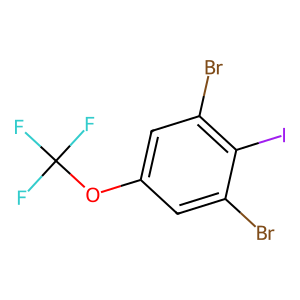
2,6-Dibromo-4-(trifluoromethoxy)iodobenzene
CAS No.:
1000578-22-2
M. Wt:
445.798
M. Fa:
C7H2Br2F3IO
InChI Key:
RDKDPUDNGOSEMG-UHFFFAOYSA-N
Names and Identifiers of 1000578-22-2
CAS Number |
1000578-22-2 |
|---|---|
MDL Number |
MFCD09878139 |
IUPAC Name |
1,3-dibromo-2-iodo-5-(trifluoromethoxy)benzene |
InChI |
InChI=1S/C7H2Br2F3IO/c8-4-1-3(14-7(10,11)12)2-5(9)6(4)13/h1-2H |
InChIKey |
RDKDPUDNGOSEMG-UHFFFAOYSA-N |
Canonical SMILES |
FC(F)(F)OC1=CC(Br)=C(I)C(Br)=C1 |
UNSPSC Code |
12352100 |
Physical and chemical properties of 1000578-22-2
Boiling Point |
289.6±40.0 °C at 760 mmHg |
|---|---|
Density |
2.4±0.1 g/cm3 |
Exact Mass |
443.746887 |
Flash Point |
128.9±27.3 °C |
Index of Refraction |
1.584 |
LogP |
5.99 |
Molecular Formula |
C7H2Br2F3IO |
Molecular Weight |
445.798 |
Vapour Pressure |
0.0±0.6 mmHg at 25°C |
Safety Information of 1000578-22-2

Applications of 1000578-22-2
2,6-Dibromo-4-(trifluoromethoxy)iodobenzene has several applications:
- Chemical Research: Used as a reagent in organic synthesis for developing more complex molecules.
- Biochemical Studies: Serves as a biochemical tool in proteomics research due to its unique structure and reactivity.
- Material Science: Potentially utilized in developing functional materials due to its electronic properties.
Interaction Studies of 1000578-22-2
Studies on the interactions of 2,6-dibromo-4-(trifluoromethoxy)iodobenzene with various nucleophiles have indicated that the trifluoromethoxy group significantly influences its reactivity profile. The electron-withdrawing nature of this group enhances electrophilic substitution reactions while also stabilizing carbocation intermediates during nucleophilic attacks.