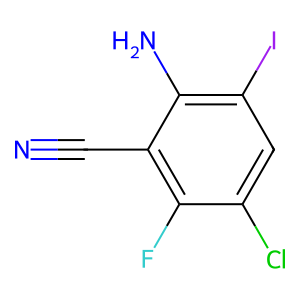
2-Amino-5-chloro-6-fluoro-3-iodobenzonitrile
Names and Identifiers of 1000577-85-4
CAS Number |
1000577-85-4 |
|---|---|
MDL Number |
MFCD09800814 |
IUPAC Name |
2-amino-5-chloro-6-fluoro-3-iodobenzonitrile |
InChI |
InChI=1S/C7H3ClFIN2/c8-4-1-5(10)7(12)3(2-11)6(4)9/h1H,12H2 |
InChIKey |
SHKGZYTZNRSZAQ-UHFFFAOYSA-N |
Canonical SMILES |
C1=C(C(=C(C(=C1I)N)C#N)F)Cl |
UNSPSC Code |
12352100 |
Physical and chemical properties of 1000577-85-4
Boiling Point |
329.8±42.0 °C at 760 mmHg |
|---|---|
Density |
2.1±0.1 g/cm3 |
Exact Mass |
295.901337 |
Flash Point |
153.2±27.9 °C |
Index of Refraction |
1.683 |
LogP |
3.58 |
Melting Point |
145 to 147°C |
Molecular Formula |
C7H3ClFIN2 |
Molecular Weight |
296.468 |
Vapour Pressure |
0.0±0.7 mmHg at 25°C |
Safety Information of 1000577-85-4

Applications of 1000577-85-4
The applications of 2-Amino-5-chloro-6-fluoro-3-iodobenzonitrile span across various fields:
- Medicinal Chemistry: As a potential drug candidate due to its biological activity.
- Proteomics Research: Utilized as a biochemical tool for studying protein interactions and functions.
- Organic Synthesis: Acts as an intermediate in the synthesis of more complex organic molecules.
Interaction Studies of 1000577-85-4
Interaction studies have shown that 2-Amino-5-chloro-6-fluoro-3-iodobenzonitrile has specific binding affinities to certain proteins and enzymes. These interactions are crucial for understanding its mechanism of action in biological systems. The compound's ability to inhibit specific cytochrome P450 enzymes suggests potential implications for drug metabolism studies.
Biological Activity of 1000577-85-4
Research indicates that 2-Amino-5-chloro-6-fluoro-3-iodobenzonitrile exhibits significant biological activity, particularly in proteomics research. It has been identified as a potential inhibitor of certain enzymes and may have applications in medicinal chemistry due to its unique structural properties that allow for interaction with biological targets.